

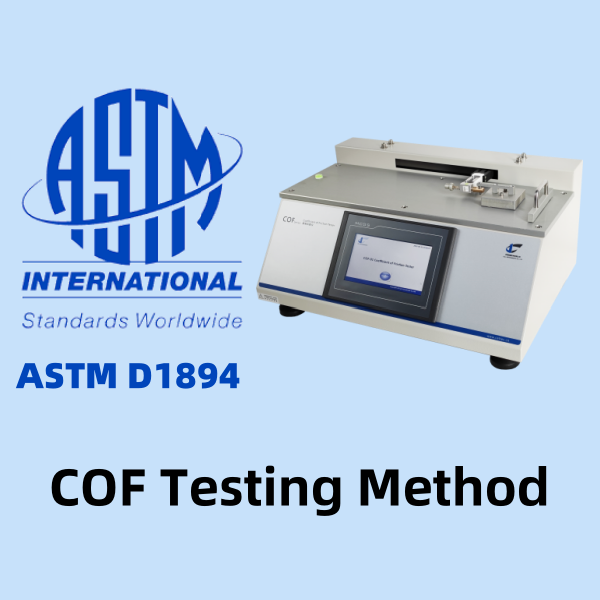
ASTM D1894
COF Test Method
Når det kommer til at evaluere glideegenskaber for plastfilm, papir, belægninger og emballagematerialer, ASTM D1894 er den internationale standard. Denne metode bestemmer både statiske og kinetiske friktionskoefficienter (COF)som er afgørende for at vurdere, hvordan materialer interagerer under forarbejdning, emballering eller slutanvendelse. Friktionsevnen påvirker direkte, hvor glat emballagematerialer kører på maskiner, og hvordan de opfører sig under stabling eller transport.
Få et tilbudUnderstanding ASTM D1894 and Its Importance
Forståelse ASTM D1894 is essential for industries such as packaging, food, medical, pharmaceutical, textiles, and quality inspection agencies, all of which rely on consistent material behavior for quality assurance.
ASTM D1894 testing outlines a clear procedure to determine the frictional characteristics between two surfaces under controlled conditions. This test is vital for:
- Evaluating packaging material performance
- Ensuring smooth production line operations
- Preventing product damage during shipping
- Meeting customer requirements for material consistency
According to the standard, a COF test involves pulling a sled—coated with or made from the test material—across a flat surface at a specified speed and pressure. The resistance encountered helps determine the static (initial) and kinetic (sliding) friction coefficients.
ASTM Coefficient of Friction Parameters and Conditions
De ASTM coefficient of friction test specified in D1894 is conducted under the following conditions:
- Testhastighed: 150 ± 30 mm/min
- Slædevægt: 200 ± 5 g
- Temperature and Humidity: Standardized environmental conditions to ensure consistency
- Specimen Dimensions: Usually 63.5 mm x 127 mm, with flat, uniform surfaces
Begge static COF (measured as the force to start motion) and kinetic COF (measured as the force to maintain motion) are calculated. The frictional force is measured in newtons and divided by the sled weight to determine the coefficient values.
Step-by-Step COF Test Method According to ASTM D1894
De COF test method omfatter følgende trin:
- Konditioner prøverne in a standardized atmosphere for at least 40 hours.
- Place the sled (facing down with the test surface) on the base material.
- Connect the sled to the force sensor via a string or hook.
- Initiate motion at a constant speed and record force values.
- Determine the static COF from the peak force before motion begins.
- Determine the kinetic COF from the average force during steady motion.
- Report the results including material type, environmental conditions, and test parameters.
Proper calibration, flat placement, and consistent speed are critical to avoid deviations.
https://youtu.be/NUgXENOz8J0Sådan vælger du den rigtige friktionstester
To meet the precise requirements of ASTM D1894, a specialized co-efficient of friction tester is necessary. A reliable tester ensures repeatability, sensitivity, and compliance with the standard. At this point, Cell Instruments’ COF-01 Coefficient of Friction Tester stands out as an ideal solution. It’s engineered for:
- Accurate static and kinetic COF measurements
- Automatic force calibration and high-speed data acquisition
- Overensstemmelse med ASTM D1894, ISO 8295, and TAPPI T816 standards
This instrument is suitable for plastic films, paper, foils, textiles, laminates, and more. It is widely adopted by QC laboratories, packaging manufacturers, converters, and research centers to improve consistency and process efficiency.

Kontakt os Få ASTM D1894-testløsning
Uanset om du er i fremstilling af plast, papir, emballage eller medicinsk udstyrat forstå og anvende ASTM D1894 giver dig en konkurrencefordel. Med den rigtige Test af friktionskoefficient ligesom COF-01 Med Cell Instruments bliver dine aktiviteter mere konsekvente, effektive og i overensstemmelse med reglerne.
Kontakt Celleinstrumenter i dag for at finde ud af, hvordan vores løsninger kan forbedre dine testmuligheder og din produktkvalitet.
Ofte stillede spørgsmål
1. What does ASTM D1894 measure?It measures the static and kinetic coefficients of friction between two surfaces, typically in packaging and materials testing.
2. Why is COF testing important in packaging?It ensures that packaging materials behave consistently during handling, transportation, and automated production.
3. What materials are tested using ASTM D1894?Common materials include plastic films, coated papers, laminates, foils, and textiles.
4. How is static COF different from kinetic COF?Static COF is the force needed to start movement, while kinetic COF is the force needed to maintain movement.
 DA
DA  EN
EN  ES
ES  DE
DE  FR
FR  IT
IT  AR
AR  KO
KO  JA
JA  RU
RU  PT
PT  VI
VI  ID
ID  BG
BG  CS
CS  EL
EL  ET
ET  FI
FI  HE
HE  HU
HU  LT
LT  LV
LV  NL
NL  PL
PL  RO
RO  SK
SK  SV
SV  SL
SL  UK
UK  TR
TR