


ASTM D4991
Rigid Containers Leakage Testing
ASTM D4991 is a specialized standard developed for rigid containers leakage testing under differential pressure conditions. In industries where containers must safely withstand air transport, pressure changes, and handling stress, leakage performance directly affects safety, compliance, and product integrity. ASTM D4991 provides a practical and observable test method that helps quality professionals identify leakage risks before containers enter real-world logistics chains.
This article explains the purpose, principles, and testing process defined in ASTM D4991, guiding laboratories and manufacturers to correctly apply the method while improving confidence in rigid container integrity.
Angebot einholenWhy ASTM D4991 Is Essential for Transport Safety
ASTM D4991 focuses on evaluating empty rigid containers subjected to vacuum conditions that simulate pressure differentials encountered during air transportation. These conditions often occur when containers move from ground level to high altitudes, where reduced external pressure can challenge seals and closures.
The standard supports compliance with international transport regulations such as UN Recommendations on the Transport of Dangerous Goods and ICAO Technical Instructions. By following ASTM D4991, manufacturers and testing laboratories can identify the pressure level at which leakage initiates, helping prevent hazardous liquid release, contamination, or package failure during shipment.
ASTM D4991 in Rigid Containers Leakage Testing and Integrity Control
ASTM D4991 plays a critical role in rigid container integrity verification by using a visual and pressure-based approach. The test relies on controlled vacuum application while containers are submerged in a transparent fluid medium, making leakage easy to detect.
Key characteristics of this approach include:
No modification to container closures or bodies
Clear visual identification of leakage through bubbles
Applicability to many rigid plastic and composite containers
Unlike flexible package tests, ASTM D4991 targets rigid formats and establishes leakage onset up to approximately 95 kPa differential pressure. This makes it particularly valuable for containers used in aviation logistics.
Bubble Leak Test Method and Vacuum Leak Detection Principle
Der bubble leak test method specified in ASTM D4991 uses immersion and vacuum leak detection to reveal defects that may not appear under normal atmospheric conditions. When vacuum pressure increases, trapped air inside a leaking container escapes through defects, producing a continuous stream of bubbles.
This method offers several advantages:
Direct visual confirmation of leakage
Clear distinction between trapped air bubbles and true leaks
Reliable detection of seal or closure weaknesses
Because the test chamber is transparent, inspectors can observe multiple specimens simultaneously while maintaining clear visibility of each closure area.
Step-by-Step Test Procedure According to ASTM D4991
To obtain accurate and repeatable results, laboratories should follow a structured procedure aligned with ASTM D4991:
Specimen immersion
Place empty rigid containers into an ethylene glycol–water solution inside a transparent vacuum chamber. Remove surface air bubbles through gentle agitation.Chamber sealing
Close the chamber lid securely. Open the inlet valve and ensure the outlet valve remains closed to prepare for controlled vacuum application.Vacuum application
Gradually increase the vacuum to the specified pressure differential, up to 95 kPa. Control the rate carefully to avoid false indications.Leak observation
Monitor containers during vacuum increase and holding time. A continuous or recurring stream of bubbles indicates leakage, while isolated bubbles typically result from trapped air.Vacuum holding period
Maintain the vacuum for at least 10 minutes. For plastic single or combination packages, extend the holding time to 30 minutes.Pressure release and inspection
Slowly release the vacuum and keep specimens immersed for at least 30 seconds at ambient pressure. Remove containers and inspect the interior for fluid ingress.
This systematic process ensures consistent results and aligns with regulatory expectations.
Supporting ASTM D4991 Testing with Reliable Equipment
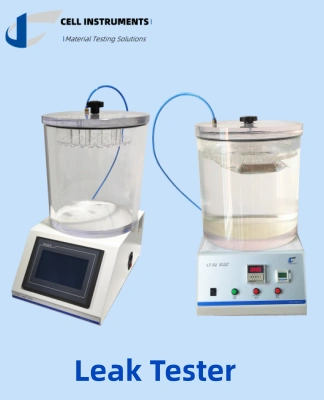
Accurate execution of ASTM D4991 depends on stable vacuum control, clear observation, and consistent pressure regulation. A professional Zellinstrumente Leak Tester offers precise vacuum adjustment, transparent test chambers, and user-friendly operation, supporting repeatable rigid containers leakage testing in laboratory environments.
Such systems help laboratories efficiently apply the bubble leak test method while maintaining confidence in data quality and test consistency.
Abschluss
ASTM D4991 establishes a clear and effective framework for evaluating rigid container leakage under simulated air transport conditions. By combining vacuum leak detection with visual bubble observation, the standard enables laboratories to identify leakage risks before containers reach the field. When paired with reliable testing equipment and disciplined procedures, ASTM D4991 becomes a powerful tool for ensuring rigid container integrity, regulatory compliance, and safe global transport.
FAQs
What pressure levels are involved in ASTM D4991 testing?ASTM D4991 typically evaluates leakage up to a differential pressure of approximately 95 kPa (13.8 psi). This range simulates pressure changes commonly experienced during air transportation.
How is leakage identified during the test?Leakage is indicated by a continuous or recurring stream of bubbles escaping from the container during vacuum application or by the presence of liquid inside the container after the vacuum is released. Isolated bubbles caused by trapped air are not considered evidence of leakage.
How many samples are required for ASTM D4991 testing?Unless otherwise specified, the standard recommends testing at least three representative specimens. Using multiple samples improves result reliability and supports quality control decision-making.
Can ASTM D4991 support regulatory compliance?Yes. ASTM D4991 is commonly used to support compliance with international regulations such as ICAO Technical Instructions Und UN Recommendations on the Transport of Dangerous Goods, particularly for rigid containers transporting liquids by air.
 DE
DE  EN
EN  ES
ES  FR
FR  IT
IT  AR
AR  KO
KO  JA
JA  RU
RU  PT
PT  VI
VI  ID
ID  BG
BG  CS
CS  DA
DA  EL
EL  ET
ET  FI
FI  HE
HE  HU
HU  LT
LT  LV
LV  NL
NL  PL
PL  RO
RO  SK
SK  SV
SV  SL
SL  UK
UK  TR
TR