
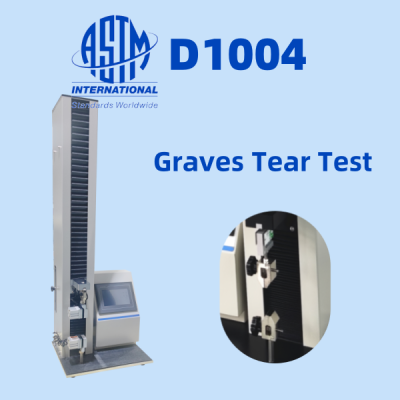
ASTM D1004 y prueba de resistencia al desgarro de Graves
Desgarro de Graves - Qué mide
El Desgarro grave evalúa la fuerza necesaria para iniciar el desgarro en una probeta entallada. A diferencia de otros métodos de desgarro que miden la propagación, este método se centra en la momento en que comienza el desgarro, que proporcionan información sobre la respuesta a la concentración de tensiones y la tenacidad del material.
Ensayo de resistencia al desgarro de películas y láminas de plástico
El prueba de resistencia al desgarro según la norma ASTM D1004 utiliza una geometría de probeta definida con precisión, una baja tasa de carga de 51 mm/min, y una máquina de separación a velocidad de agarre constante. Esta configuración garantiza que el ensayo refleje el comportamiento real del material sin enmascarar los puntos débiles causados por la variación del espesor o los defectos locales.
Por qué es importante la resistencia al desgarro de las láminas y películas de plástico
El resistencia al desgarro de películas y láminas de plástico afecta a los factores clave del rendimiento:
- Durabilidad del envase durante la manipulación
- Resistencia a los fallos iniciados por punción
- Retención de la junta cuando se somete a cargas mecánicas
- Idoneidad para aplicaciones médicas, farmacéuticas, alimentarias o industriales
Dado que la resistencia al desgarro depende de la composición del polímero, la orientación y las condiciones de procesado, la norma ASTM D1004 ofrece una forma estandarizada y fiable de comparar materiales con rangos de grosor similares.
Principios fundamentales y condiciones de ensayo de la norma ASTM D1004
1. Carga controlada y geometría de la probeta
ASTM D1004 requiere una forma de espécimen que genere un concentración de tensiones cerca de la muesca. Esto permite que el desgarro se produzca en una región definida, lo que permite obtener resultados repetibles incluso con películas flexibles.
2. Carga máxima como valor de resistencia al desgarro
El fuerza máxima observada al inicio del desgarro representa la resistencia al desgarro del material. Es importante destacar que la norma especifica que las fuerzas de desgarro deben no normalizarse por grosor a través de variaciones amplias, ya que hacerlo puede llevar a conclusiones inexactas.
3. Limitaciones materiales
ASTM D1004 se aplica mejor cuando:
- La película no falla de forma quebradiza
- La extensión material es menos de 200%
- La variación del espesor se mantiene dentro de ±10%
Estas restricciones mantienen la credibilidad de los resultados y evitan errores provocados por comportamientos extremos de elongación o fractura.
Paso a paso del procedimiento de ensayo ASTM D1004
1. Preparación de las muestras
Prepare las probetas siguiendo las dimensiones y la geometría de entalladura normalizadas. Mida el espesor en varios puntos dentro de la zona entallada para mejorar la precisión.
2. Configuración de la máquina
- Separación inicial del agarre: 25,4 mm
- Velocidad de agarre: 51 mm/min
- Modo de separación con velocidad de agarre constante
3. Posicionamiento
Alinee el eje largo de la probeta con la línea central de las mordazas para evitar torsiones o cargas desiguales.
4. Ejecución de la prueba
Tire de la probeta hasta que se produzca la rotura completa. La máquina registra los datos de carga-tiempo o carga-desplazamiento.
5. Registro y cálculo de datos
- Carga máxima de desgarro registrada a tres cifras significativas
- Extensión máxima registrada a dos cifras significativas
- Media y desviación típica calculadas para cada orientación de la película
Cómo elegir el medidor de desgarro de tumbas adecuado
Utilizar el equipo adecuado es esencial para obtener datos de iniciación al desgarro estables y de alta precisión. Una máquina de ensayos moderna debe proporcionar una medición precisa de la fuerza, un control de accionamiento estable, una alineación adecuada de la pinza y accesorios de muestra adaptables.
Ayudar a los laboratorios a cumplir estos requisitos con eficacia, Cell Instruments ofrece el TST-01, El TST-01 es un versátil sistema de ensayo de tracción y desgarro diseñado para el análisis de películas de alta repetibilidad. El TST-01 cuenta con un control preciso de la velocidad, un bastidor rígido y accesorios especializados adecuados para Medidas del desgarro de Graves, lo que la convierte en una excelente opción para las empresas que deseen cumplir plenamente la norma ASTM D1004 y, al mismo tiempo, mejorar el flujo de trabajo de las pruebas.
Póngase en contacto con nosotros Obtenga la solución de pruebas ASTM D1004
Para laboratorios que buscan un cumplimiento fiable, repetible y eficiente de ASTM D1004, soluciones avanzadas como el Cell Instruments TST-01 aportan un valor significativo y ayudan a garantizar un alto nivel en la evaluación del rendimiento de los materiales.
 ES
ES  EN
EN  DE
DE  FR
FR  IT
IT  AR
AR  KO
KO  JA
JA  RU
RU  PT
PT  VI
VI  ID
ID  BG
BG  CS
CS  DA
DA  EL
EL  ET
ET  FI
FI  HE
HE  HU
HU  LT
LT  LV
LV  NL
NL  PL
PL  RO
RO  SK
SK  SV
SV  SL
SL  UK
UK  TR
TR  BE
BE  BS
BS  HI
HI  HR
HR  KK
KK  ML
ML  MY
MY  NN
NN  SR
SR  TA
TA  UZ
UZ  SQ
SQ