

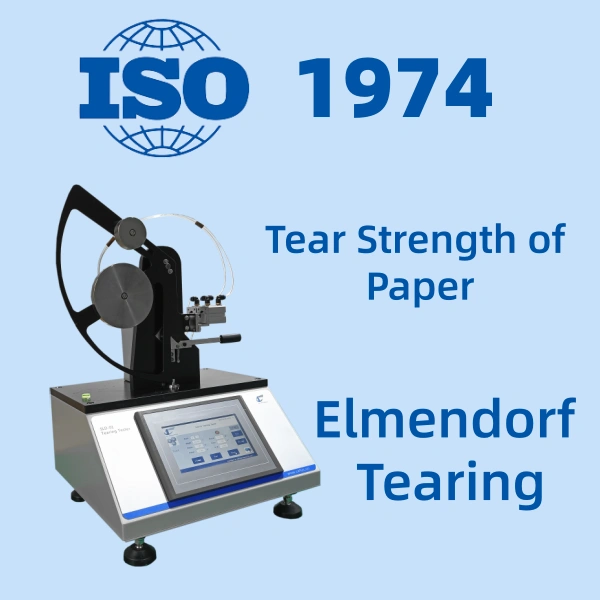
ISO 1974
Elmendorf Tear Strength of Paper
ISO 1974 defines the international methodology for measuring the tearing resistance of paper using the Elmendorf method.
ISO 1974 focuses specifically on the out-of-plane tearing mechanism, which simulates the way paper tears under real handling or converting conditions.
קבל הצעת מחירHow ISO 1974 Defines Tearing Resistance
The standard describes a sequence in which the operator places four superimposed sheets into an Elmendorf pendulum tester, introduces an initial cut, and allows the pendulum to tear through a defined distance. The energy lost by the pendulum represents the work required to propagate the tear. From this, laboratories calculate the mean tearing force per sheet.
The standard applies mainly to paper and lightweight boards whose tearing resistance falls within the capability range of Elmendorf-type instruments. ISO 1974 recommends selecting a pendulum capacity that ensures readings remain between 20% and 80% of the tester’s scale, maximizing accuracy and repeatability.
Why Tearing Resistance Matters
The tear strength of paper directly influences converting performance, packaging integrity, and end-use durability. Insufficient resistance often results in web breaks, poor runnability, or consumer complaints. Conversely, excessive resistance may hinder operations such as opening features, creasing, or perforation. ISO 1974 offers a reliable measurement framework that helps balance these requirements.
Key Principles of the Elmendorf Tearing Method
Controlled Tear Propagation
ISO 1974 uses a single tear line created after firmly clamping the stacked sheets. By standardizing sheet count, tear distance, and pendulum motion, the test isolates the tearing property rather than the influence of operator technique.
Pendulum and Mass Selection
The tear value should fall in the recommended operating range. Working outside the range increases test uncertainty. Modern instruments simplify this selection with modular or automatically recognized pendulum masses.
Data Quality and Reporting
ISO 1974 calls for separate reporting of tearing resistance in both directions, including the coefficient of variation. Digital reporting systems help teams reduce transcription errors, preserve traceability, and accelerate root-cause analysis during quality investigations.
Choosing Right Elmendorf Tester from Cell Instruments
Paper and packaging laboratories aim for instruments that deliver precision, durability, and data assurance. The Cell Instruments SLD-01 Tearing Tester aligns closely with the operational expectations established by ISO 1974 and strengthens laboratory workflow efficiency.
היתרונות העיקריים כוללים:
- Pneumatic clamping that ensures uniform gripping across all test pieces, improving repeatability.
- Automatic pendulum release, eliminating operator timing errors that often compromise traditional manual testers.
- Multiple pendulum capacities covering light to heavy papers, enabling one instrument to support a wide test range.
- Industrial-grade PLC control with touchscreen navigation, which reduces training time and enhances productivity.
- Optional tear-index output and professional software, supporting pulp and paper standards and advanced reporting.

FAQs about ASTM D5884
1. What is ISO 1974?ISO 1974 is the international standard that defines the Elmendorf method for determining the tearing resistance of paper and lightweight boards. It provides a unified procedure for measuring the force required to propagate a tear through a test piece.
2. What does tearing resistance indicate about paper quality?Higher tearing resistance generally signals stronger fiber bonding and better structural integrity. Low values may lead to processing issues, poor runnability, or product failures in packaging applications.
3. Which materials can be tested using ISO 1974?ISO 1974 applies to most types of paper and lightweight boards whose tearing resistance falls within the selected pendulum range of an Elmendorf tear tester.
4. How many sheets are required in each test piece according to ISO 1974?The standard requires four superimposed sheets for each test specimen. However, when necessary, more or fewer sheets may be used, provided this deviation is clearly stated in the test report.
5. Why does ISO 1974 require measurements in both machine direction and cross direction?Paper exhibits anisotropy due to fiber orientation during manufacturing. Testing both directions ensures a complete understanding of material behavior and helps diagnose production inconsistencies.
6. What factors can cause invalid test results in the Elmendorf tearing test?Improper pendulum selection, extreme tear deviation, incomplete tearing, operator influence, curling sheets, or readings falling outside 20–80 percent of the measurement range may require rejection or retesting.
7. How is the tear index calculated under ISO 1974?The tear index normalizes tearing resistance by grammage using the formula
X = F / g,
where F is the tearing resistance per sheet and g is the basis weight in grams per square meter. It is useful for comparing papers with different grammages.
Contact Us Get ISO 1974 Testing Solution
ISO 1974 provides a robust methodology that helps manufacturers and laboratories quantify the tearing resistance of paper with accuracy and comparability. By coupling the standard’s principles with high-precision instruments such as the Cell Instruments SLD-01 Tearing Tester, organizations can elevate quality assurance, stabilize production, and build confidence in their materials.
 HE
HE  EN
EN  ES
ES  DE
DE  FR
FR  IT
IT  AR
AR  KO
KO  JA
JA  RU
RU  PT
PT  VI
VI  ID
ID  BG
BG  CS
CS  DA
DA  EL
EL  ET
ET  FI
FI  HU
HU  LT
LT  LV
LV  NL
NL  PL
PL  RO
RO  SK
SK  SV
SV  SL
SL  UK
UK  TR
TR