
The Importance of Flex Durability in Packaging Applications
Flex durability is a critical quality attribute for packaging materials, especially in sectors like medical, औषधि संबंधी, और food packaging, where barrier performance must remain intact over time. Packaging films that lose integrity due to repetitive flexing can lead to pinhole failures, moisture intrusion, or oxygen ingress, all of which compromise product safety and shelf life.
एएसटीएम एफ392 allows manufacturers to:
- Simulate transportation and handling stresses
- Evaluate design differences in multi-layer films
- Predict the shelf performance of packaging under mechanical strain
- Compare the performance of different material structures
- Support R&D and quality assurance decisions
In combination with post-conditioning tests such as gas transmission rate (GTR) या moisture vapor transmission rate (MVTR) evaluations, ASTM F392 becomes a foundational practice in packaging quality assurance.
Understanding ASTM F392 and Its Purpose
एएसटीएम एफ392, आधिकारिक शीर्षक लचीले स्थायित्व के लिए लचीली बाधा सामग्री की कंडीशनिंग के लिए मानक अभ्यास, provides a systematic approach for pre-conditioning specimens before evaluating their mechanical or barrier properties. While it does not directly test final barrier or mechanical performance, it defines consistent conditioning protocols that simulate real-world flexing conditions.
The standard outlines five conditioning levels (A to E), each simulating a different degree of mechanical stress. These conditions vary in flex cycles from 20 to 2700, enabling precise tailoring based on material type and intended application. Whether the goal is to assess pinhole formation, gas permeability, or multi-ply delamination, ASTM F392 lays the groundwork for reliable and reproducible testing.
Gelbo Flex Tester: The Core Instrument Behind ASTM F392
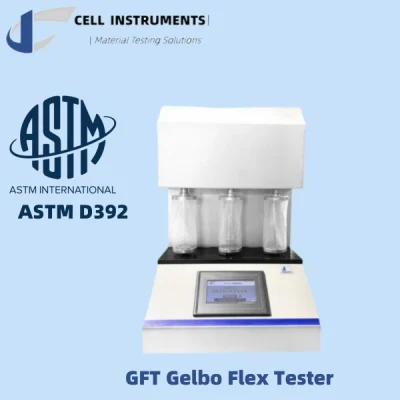
A critical component of the एएसटीएम एफ392 procedure is the Gelbo flex tester. This apparatus replicates the multidirectional stresses experienced by films during flexing. Its motion combines twisting (up to 440°) और horizontal crushing, effectively simulating real-use conditions.
The Gelbo test method uses this mechanical action to flex the sample at a rate of 45 cycles per minute, under controlled temperature and humidity. Depending on the test objective—whether to study flex-induced barrier degradation or the emergence of सूक्ष्म छिद्र—the tester is configured for full or partial flex conditions.
The Cell Instruments Flex Durability Tester offers a precise implementation of the Gelbo flex method, fully compliant with ASTM F392. Designed with adjustable flex stroke and cycle control, it supports all conditioning levels (A to E), ensuring high reproducibility and testing efficiency.
Advantages of the Gelbo Test Method for Flex Durability
Integrating the gelbo test method within the ASTM F392 framework provides measurable benefits:
- Standardized Flexing Motion: Reproduces realistic mechanical fatigue using a defined twisting and compression path.
- Controlled Test Conditions: Humidity and temperature conditions are regulated for consistent results.
- Quantifiable Outcomes: Pinhole count, barrier integrity, or mechanical strength post-flex can be objectively assessed.
- Multi-Ply Analysis: Supports the evaluation of structural failures in complex laminates.
By using ASTM F392 alongside complementary standards like एएसटीएम एफ88 (seal strength) or ASTM F1249 (WVTR), manufacturers obtain a full profile of their packaging film’s performance under stress.
Choosing the right Leak Tester
At Cell Instruments, we specialize in testing solutions for flexible packaging. Our फ्लेक्स टिकाऊपन परीक्षक is specifically engineered to meet ASTM F392 specifications. With programmable conditioning levels, precision motion control, and customizable configurations, it supports both R&D और QA workflows.
Whether you are a packaging engineer, lab technician, or quality assurance specialist, our instruments empower you to:
- Identify weaknesses in material design
- Validate compliance with ASTM protocols
- Ensure long-term barrier performance in critical applications
Combined with our expertise in custom testing solutions और automated platforms, Cell Instruments offers comprehensive support for advanced packaging material testing.
Contact Us Get Coefficient Of Friction Testing Solution
एएसटीएम एफ392 is a vital standard for evaluating the flex durability of flexible barrier materials. Through controlled mechanical conditioning using the Gelbo flex tester, manufacturers gain critical insights into how packaging films perform under real-world stress. The gelbo test method allows precise simulation of flexing environments, enabling detection of potential failure points before packaging reaches the market.
For businesses seeking robust, repeatable flex testing capabilities, सेल उपकरण‘ flex durability tester provides a trusted solution that aligns with international standards and industry needs.
 HI
HI  EN
EN  ES
ES  DE
DE  FR
FR  IT
IT  AR
AR  KO
KO  JA
JA  RU
RU  PT
PT  VI
VI  ID
ID  BG
BG  CS
CS  DA
DA  EL
EL  ET
ET  FI
FI  HE
HE  HU
HU  LT
LT  LV
LV  NL
NL  PL
PL  RO
RO  SK
SK  SV
SV  SL
SL  UK
UK  TR
TR  BE
BE  BS
BS  HR
HR  KK
KK  ML
ML  MY
MY  NN
NN  SR
SR  TA
TA  UZ
UZ  SQ
SQ