

Geomembrane Thickness Test
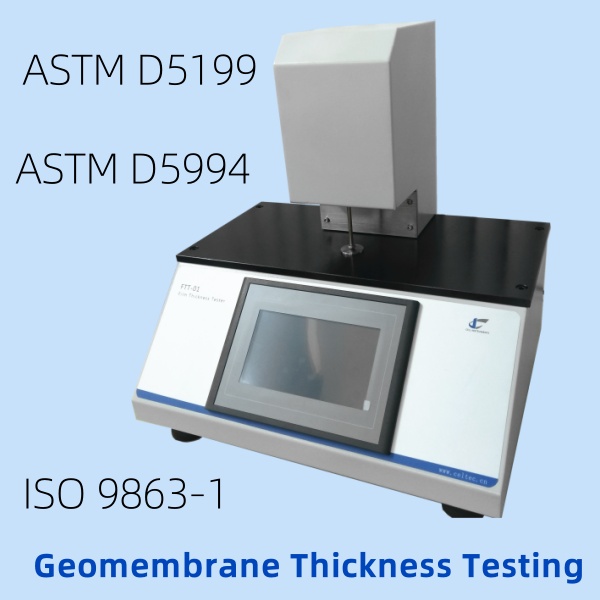
Accurate measurement of geomembrane thickness is essential for assessing product quality, ensuring structural reliability, and meeting international standards. The geomembrane thickness test provides vital data for evaluating uniformity and performance, directly influencing mechanical strength, permeability, and service life. In geotechnical and environmental engineering, reliable thickness control helps guarantee barrier integrity in applications such as landfills, reservoirs, and containment systems.
Importance of Measuring the Thickness of Geomembranes
The thickness of geomembranes is a key physical property that defines durability and functionality. Variations in thickness can lead to inconsistent mechanical behavior, reducing tensile strength or increasing the risk of leakage. Therefore, standardized test methods like ASTM D5199, ASTM D5994, और ISO 9863-1 ensure repeatable and comparable results across laboratories.
Thickness measurement not only serves as a quality control parameter but also supports material specification, product certification, and performance prediction under load or environmental stress. In short, accurate testing prevents costly failures in real-world applications.
ASTM D5199, ASTM D5994, and ISO 9863-1
ASTM D5199 — Nominal Thickness of Smooth Geomembranes
ASTM D5199 outlines the procedure for measuring nominal thickness in smooth geomembranes and other geosynthetics. The test involves applying a specific pressure using a flat presser foot (usually 20 kPa for geomembranes) and recording the distance between two parallel surfaces after five seconds. This method ensures that compressibility and deformation effects are minimized.
The results are reported to the nearest 0.02 mm, providing a consistent and accurate representation of material uniformity. It is particularly suitable for acceptance testing of commercial shipments and quality assurance of production batches.
ASTM D5994 — Core Thickness of Textured Geomembranes
Textured geomembranes, which feature rough surfaces for improved frictional performance, require a different approach. ASTM D5994 specifies measurement of core thickness, focusing on the distance between two gauge points that fit into the “valleys” of the textured surface.
A controlled force of approximately 0.56 N is applied to avoid compressing surface textures. The method takes three readings per specimen and records the lowest value, ensuring that only the true core thickness is evaluated. This test minimizes measurement variability and ensures accurate assessment of mechanical strength and permeability characteristics.
ISO 9863-1 — Thickness of Geosynthetics Under Specified Pressure
ISO 9863-1 provides internationally harmonized procedures for determining the thickness of various geosynthetics, including geomembranes and geotextiles. The test measures the distance between two parallel plates under a defined load and pressure, usually after a conditioning period.
This standard emphasizes consistency of testing conditions — such as temperature, pressure, and presser foot size — to ensure interlaboratory comparability. Results obtained following ISO 9863-1 are often required for international trade and project documentation.
Factors Affecting Geomembrane Thickness Measurement
Several factors influence the accuracy of geomembrane thickness measurements:
- Surface texture and compressibility: Textured or structured geomembranes can yield variable readings if excessive pressure is applied.
- Temperature and conditioning: Material stiffness changes with temperature; hence, controlled laboratory conditions are essential.
- Measurement pressure: The applied load must comply with the standard to avoid deformation.
- Handling of samples: Cutting or bending can alter local thickness; specimens must be handled carefully before testing.
Maintaining strict adherence to standard test procedures minimizes errors and ensures that data accurately reflect material characteristics.
सही मोटाई परीक्षक का चयन
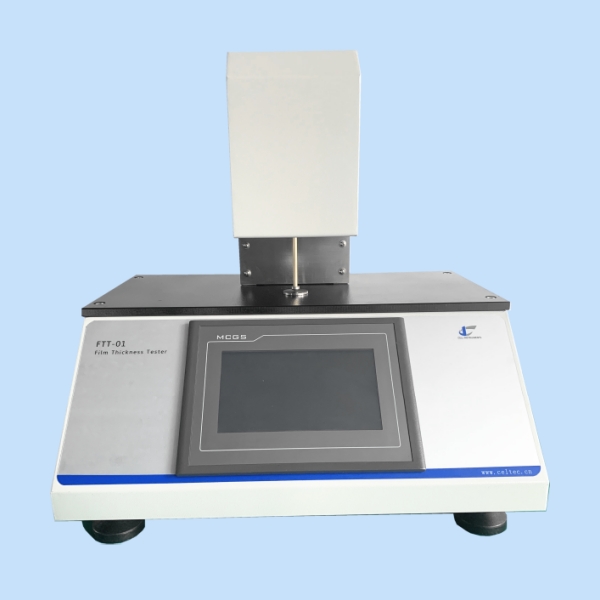
To achieve consistent and reliable results, laboratories and manufacturers can rely on the Cell Instruments FTT-01 Thickness Tester. This advanced instrument is designed for precision thickness measurements of geomembranes, films, paper, and other flexible materials.
The FTT-01 features high-accuracy displacement sensors, customizable presser foot diameters, and adjustable test pressures in accordance with ASTM D5199, ASTM D5994, and ISO 9863-1. Its automated test cycle ensures operator-independent readings, enhancing repeatability and productivity.
By integrating the FTT-01 into quality control processes, users can ensure compliance with global standards and maintain the reliability of geomembrane production lines.
पूछे जाने वाले प्रश्न
1. What is the purpose of a geomembrane thickness test?
The geomembrane thickness test determines the nominal or core thickness of a geomembrane to evaluate material uniformity, strength, and compliance with standards such as ASTM D5199 and ASTM D5994.
2. Why do textured geomembranes require a different testing method?
Textured geomembranes have uneven surfaces that prevent full plate contact. ASTM D5994 specifies testing at the “valleys” between textures under light pressure to measure true core thickness accurately.
3. How does thickness affect geomembrane performance?
Thicker geomembranes generally offer higher puncture resistance, tensile strength, and barrier properties. However, uniformity across the sheet is more critical than overall thickness.
4. What are the advantages of using the FTT-01 Thickness Tester?
The FTT-01 offers automated, high-precision measurements, adjustable pressure settings, and compliance with ASTM and ISO standards — ideal for both research and quality control in geomembrane production.
5. Which standards are most commonly used for geomembrane thickness testing?
The most widely used standards are ASTM D5199 for smooth geomembranes, ASTM D5994 for textured geomembranes, and ISO 9863-1 for general geosynthetic materials.
Contact Us Get Geomembrane Thickness Testing Solution
Accurate determination of geomembrane thickness is essential for ensuring product integrity, regulatory compliance, and long-term performance. By following standardized test methods such as ASTM D5199, ASTM D5994, और ISO 9863-1, professionals can obtain reliable data critical for design and quality assurance.
The Cell Instruments FTT-01 Thickness Tester provides a dependable solution for laboratories and manufacturers seeking precision and compliance in their geomembrane thickness test operations — a key step toward delivering high-quality, durable geosynthetic materials.
 HI
HI  EN
EN  ES
ES  DE
DE  FR
FR  IT
IT  AR
AR  KO
KO  JA
JA  RU
RU  PT
PT  VI
VI  ID
ID  BE
BE  BG
BG  BS
BS  CS
CS  DA
DA  EL
EL  ET
ET  FI
FI  HE
HE  HR
HR  HU
HU  KK
KK  LT
LT  LV
LV  ML
ML  MY
MY  NN
NN  NL
NL  PL
PL  RO
RO  SK
SK  SR
SR  SV
SV  TA
TA  SL
SL  UK
UK  UZ
UZ  TR
TR  SQ
SQ