

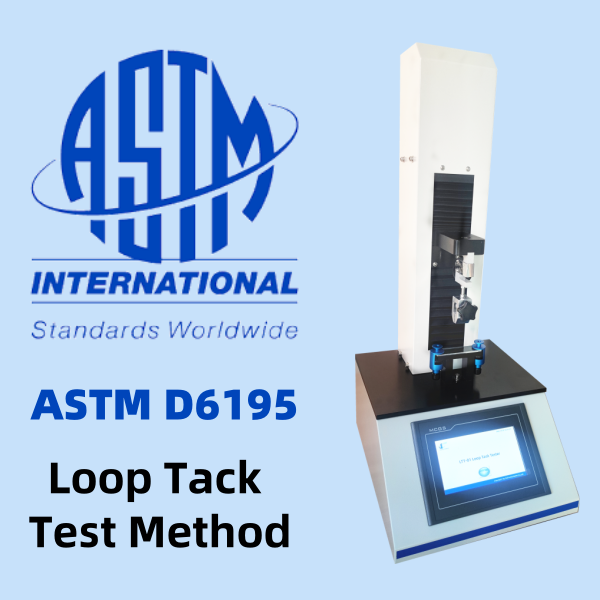
ASTM D6195
Metodo di prova del Loop Tack
Pressure-sensitive adhesives (PSAs) are critical in industries ranging from packaging to medical devices, where their ability to bond instantly under light pressure determines product reliability. ASTM D6195 is a standardized test method used to evaluate the tack properties of pressure-sensitive adhesives. This test determines the initial adhesion strength, also known as loop tack, which is crucial for applications such as labels, tapes, and medical bandages.
PreventivoWhat Is the ASTM D6195 Loop Tack Test Method?
ASTM D6195 outlines procedures to quantify the tack force of adhesives, which is the force required to separate a PSA from a substrate shortly after contact. This test simulates real-world scenarios where adhesives must form instant bonds, such as labels, tapes, or medical dressings.
The standard defines two test methods, each suited for different laboratory setups:
1. Test Method A: Using a Misuratore di trazione
Specimen Requirements: A 7-inch (175 mm) adhesive strip is looped with the adhesive facing outward.
Procedura: The loop contacts a stainless steel panel (25×25 mm) under controlled conditions. A tensile tester measures the force needed to detach the adhesive.
Industries Served: Ideal for labs already equipped with tensile testing machines.
2. Test Method B: Using a Tester di aderenza ad anello
Specimen Requirements: A shorter 5-inch (125 mm) strip is used, designed specifically for loop tack testers.
Procedura: The loop is clamped into a dedicated tester, which automates contact and detachment cycles. This method ensures high repeatability and is favored for high-throughput testing.
Industries Served: Packaging, medical device manufacturers, and adhesive producers requiring rapid, precise results.
Equipment Required for ASTM D6195 Testing
To perform the prova di aderenza ad anello, specific instruments and materials are required:
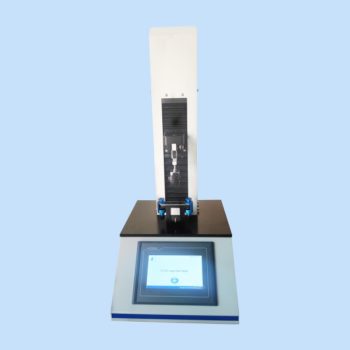
Tester di aderenza ad anello: A specialized instrument for measuring loop tack force.
Stainless Steel Test Panels: 25 mm × 150 mm panels, ensuring a consistent test surface.
Die Cutter: Used for precise sample preparation.
Cleaning Reagents: Acetone, n-heptane, or ethanol-based solutions to clean test surfaces.
Masking Tape: Used for securing the specimen loop.
PET Film: A support medium for transfer adhesives.
Each component plays a critical role in obtaining accurate E ripetibile test results.
How to Conduct a Loop Tack Test
Preparazione del campione
Cut adhesive samples into 1-inch × 5-inch (25 mm × 125 mm) strips.
Condition the samples at 23°C (73.4°F) and 50% relative humidity per almeno 24 hours.
Clean the stainless steel test panels using appropriate reagents.
Procedura di prova
Set up the loop tack tester: Ensure it is leveled and powered on.
Prepare the adhesive loop: Bend the strip back on itself without creasing, forming a teardrop shape.
Secure the loop with masking tape.
Insert the loop into the tester: Position it correctly for uniform contact.
Initiate the test cycle: The tester presses the loop onto the surface and then pulls it away.
Record the peak force required to separate the adhesive loop from the panel.
Repeat the test at least three times per adhesive sample.
Scelta del giusto Loop Tack Tester
For businesses involved in adhesive testing, investing in a high-quality loop tack tester is essential. The Cell Instruments Loop Tack Tester provides:
Precision measurement of tack force.
Funzionamento facile da usare with automated testing.
Reliable data for research and quality control.
Contattateci per ottenere una soluzione per il test del Loop Tack
ASTM D6195 is a fundamental standard for evaluating adesivi sensibili alla pressione utilizzando il Metodo di prova dell'aderenza ad anello. Seguendo le procedure corrette e utilizzando un tester di aderenza ad anello, i produttori possono garantire prestazioni adesive di alta qualità. Per soluzioni di test avanzate, Cell Instruments' Loop Tack Tester è una scelta leader nel settore.
Domande frequenti
1. What is ASTM D6195?ASTM D6195 is a standard test method that measures the loop tack of pressure-sensitive adhesives using a loop tack tester or tensile tester.
2. What is a loop tack test?The loop tack test measures the initial adhesion strength of an adhesive by determining the force needed to separate it from a surface after controlled contact.
3. Why is loop tack important?Loop tack indicates an adhesive’s quick-stick capability, essential for labels, medical tapes, and packaging materials.
4. How does a loop tack tester work?A loop tack tester applies an adhesive loop onto a surface and then pulls it away, recording the maximum force required to break the bond.
 IT
IT  EN
EN  ES
ES  DE
DE  FR
FR  AR
AR  KO
KO  JA
JA  RU
RU  PT
PT  VI
VI  ID
ID  BG
BG  CS
CS  DA
DA  EL
EL  ET
ET  FI
FI  HE
HE  HU
HU  LT
LT  LV
LV  NL
NL  PL
PL  RO
RO  SK
SK  SV
SV  SL
SL  UK
UK  TR
TR