

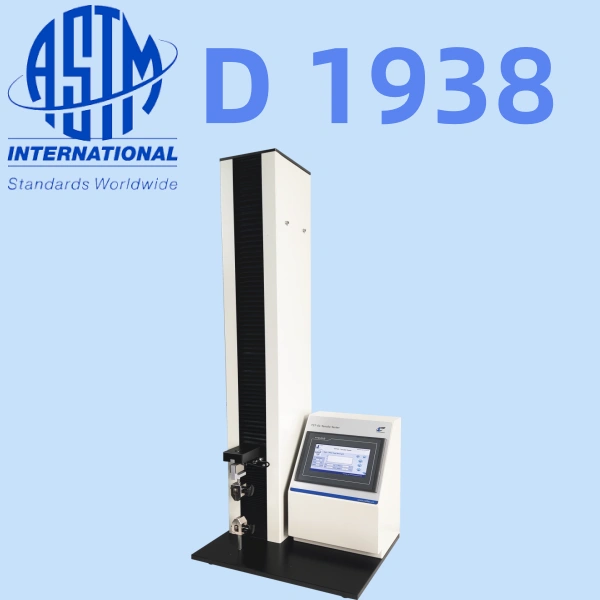
ASTM D1938
Trouser Tear Test for Plastic Film Resistance
ASTM D1938 is a widely recognized standard used to evaluate resistenza alla propagazione dello strappo in plastic films and thin sheeting. In many packaging, medical, and industrial applications, plastic films experience repeated mechanical stress during processing, transport, and end use. A small initial cut can easily grow into a catastrophic failure if the material lacks sufficient resistance to tear propagation. ASTM D1938 addresses this risk by providing a controlled and repeatable metodo di prova dello strappo that focuses on tear growth rather than tear initiation.
For quality control personnel and material engineers, ASTM D1938 offers practical insight into how plastic films behave once a tear has started. This makes the method especially valuable for comparing materials of similar thickness and composition in real production environments.
PreventivoASTM D1938 Trouser Tear Test Principle
IL trouser tear method defined in ASTM D1938 measures the force required to propagate a single tear through a plastic film specimen. The specimen is prepared with a central slit that forms two “legs,” resembling a pair of trousers. Each leg is clamped into a tensile testing machine, and the grips separate at a constant rate.
During the test, the instrument records the force needed to continue tearing the film across a defined distance. This force reflects the material’s resistenza alla propagazione dello strappo, which differs from tensile strength or puncture resistance. In practice, a film with high tensile strength may still perform poorly in a tear test of plastic film if the tear propagates easily once initiated.
Why Tear Propagation Resistance Matters
In plastic film applications, tear resistance influences both performance and safety. Packaging films for food, pharmaceuticals, and medical devices must resist tearing during sealing, handling, and distribution. Agricultural films, industrial liners, and protective sheeting face similar demands.
IL metodo di prova dello strappo described in ASTM D1938 helps manufacturers:
- Compare materials with similar thickness and formulation
- Optimize film structures for durability
- Reduce product failures caused by uncontrolled tearing
- Support material selection during product development
Because the method focuses on tear propagation resistance, it provides data that correlate well with many real-world failure modes.
Specimen Preparation and Test Conditions
ASTM D1938 specifies strict requirements for specimen dimensions, thickness uniformity, and conditioning. Proper preparation ensures that results reflect material behavior rather than test variability. Specimens are typically tested in both machine direction and transverse direction to capture anisotropic properties common in extruded films.
Conditioning at controlled temperature and humidity plays an important role in result consistency. Plastic films often show sensitivity to environmental conditions, and standardized conditioning improves repeatability across laboratories.
Interpreting Results from the Tear Test of Plastic Film
The output of an ASTM D1938 test is usually expressed as an average tear-propagation force. For less extensible films, the force remains relatively stable during tearing. Highly extensible films may show fluctuating force values, requiring careful interpretation of the load–extension curve.
When comparing materials, it is essential to consider thickness, direction, and film structure. ASTM D1938 data rank materials effectively within similar groups, though they do not always predict final end-use performance on their own.
ASTM D1938 Compared with Other Tear Test Methods
Several tear test methods exist, including Elmendorf and tongue tear tests. ASTM D1938 differs by emphasizing resistenza alla propagazione dello strappo under controlled grip separation rather than impact or peak force measurement. For plastic films and thin sheeting, this approach provides more relevant data, especially when films experience slow, continuous tearing in service.
Selecting the correct tear test method ensures meaningful results and avoids misinterpretation during quality evaluation.
Testing Solutions from Cell Instruments
Accurate ASTM D1938 testing requires a stable tester di trazione with precise speed control, reliable force measurement, and suitable grips for trouser tear specimens. Strumenti cellulari provides advanced tensile testing systems designed to meet ASTM D1938 requirements while supporting flexible configuration for different film materials.
Beyond standard testing, Cell Instruments also supports customized fixtures, automation upgrades, and tailored testing solutions for packaging, medical, pharmaceutical, and plastic film manufacturers. These capabilities help laboratories improve efficiency, data reliability, and compliance with international standards.
Contact Us Get ASTM D1938 Testing Solution
ASTM D1938 remains a key standard for evaluating resistenza alla propagazione dello strappo in plastic films. By focusing on how a tear grows under controlled conditions, this metodo di prova dello strappo delivers practical, comparable data for material selection and quality control. With reliable testing equipment and technical expertise from Cell Instruments, manufacturers can confidently assess tear performance and enhance product durability across diverse applications.
Domande frequenti
1. What is the ASTM D1938 standard?ASTM D1938 is a standard test method used to measure the force required to propagate a tear in plastic film and thin sheeting (thickness ≤ 1 mm) using a single-tear method. This method is crucial for assessing the tear propagation resistance of plastic films, which is important in packaging and material selection processes. The core focus of this test is to measure the force needed for a tear to extend from an initial cut across the material.
2. What is the trouser tear test?IL trouser tear test is a method described in ASTM D1938. It involves cutting a “trouser-shaped” slit into a film specimen, clamping the two “legs” of the slit in the test machine, and pulling the specimen at a constant rate. The force required to propagate the tear is measured during the test. This method helps assess how easily a tear can spread in plastic films under stress.
3. How is ASTM D1938 different from other tear testing methods?ASTM D1938 specifically focuses on measuring the resistance to tear propagation once the tear has already initiated, whereas other methods like the Elmendorf tear test focus on the force required to initiate the tear. This makes ASTM D1938 especially useful for plastic films, as it simulates the real-world tearing process, where a tear starts and spreads across the material, instead of just testing the material’s resistance to initial breakage.
4. What types of films does ASTM D1938 apply to?ASTM D1938 is applicable to plastic films and thin sheeting with a thickness of up to 1 mm. This is particularly significant for films that are less than 0.25 mm (0.010 inches) thick. The test method is not suitable for films that exhibit brittle failures during testing, and the method is specifically designed for materials that do not tear in the cross direction during the test.
 IT
IT  EN
EN  ES
ES  DE
DE  FR
FR  AR
AR  KO
KO  JA
JA  RU
RU  PT
PT  VI
VI  ID
ID  BG
BG  CS
CS  DA
DA  EL
EL  ET
ET  FI
FI  HE
HE  HU
HU  LT
LT  LV
LV  NL
NL  PL
PL  RO
RO  SK
SK  SV
SV  SL
SL  UK
UK  TR
TR