

ASTM D2063
Removal Torque Testing for Package Closures
 ASTM D2063 plays a central role in the evaluation of removal torque for continuous thread closures used in packaging systems. In packaging quality control, torque performance directly affects seal integrity, consumer usability, and product safety. By defining standardized test methods, ASTM D2063 helps manufacturers, brand owners, and laboratories achieve consistent and comparable results across different packaging designs and materials.
This article provides a complete and concise introduction to the test purpose, testing process, and application materials defined in ASTM D2063, with practical insight into how modern torque testing solutions, such as Cell Instruments’ TT-01, support compliance and efficiency.
Why ASTM D2063 Matters in Packaging Torque Evaluation
ASTM D2063 establishes a quantitative method for measuring the removal torque of continuous thread closures on containers under predetermined environmental conditions and over defined time intervals. The standard focuses on torque retention, which reflects how well a closure maintains its applied torque during storage, transportation, and distribution.
For packaging professionals, ASTM D2063 supports:
- Packaging development and engineering evaluation
- Comparison of different closure designs, liner materials, and container finishes
- Validation of packaging performance under controlled and simulated distribution conditions
By following ASTM D2063, laboratories reduce variability and improve confidence in torque-related decisions.
Torque Tester for Packages and Closure Torque Tester Applications
UM removal torque test measures the maximum torque required to loosen a closure from a container. This value indicates whether the package remains secure while still being openable by the end user. A reliable torque tester for packages ou closure torque tester ensures accurate measurement without distorting the container or closure.
Typical applications include:
- Plastic bottles with screw caps
- Glass containers with continuous thread closures
- Pharmaceutical, food, beverage, and cosmetic packaging
ASTM D2063 supports both laboratory-based evaluations e distribution-related assessments, making it relevant across the entire packaging lifecycle.
Overview of ASTM D2063 Test Methods
ASTM D2063 defines two complementary approaches that address different testing objectives.
Static Evaluation for Controlled Storage Conditions
Static evaluation focuses on torque retention over time under controlled environmental conditions. Closures are applied at a known application torque and stored at specified temperatures and humidity levels. Removal torque measurements take place at predetermined intervals such as immediate, 24 hours, 7 days, or longer.
This approach helps engineers understand:
- Long-term closure performance
- Material relaxation and liner behavior
- Effects of temperature and humidity on torque loss
Dynamic Evaluation for Distribution Simulation
Dynamic evaluation integrates distribution testing practices, such as those defined in ASTM D4169. Packages undergo simulated transportation cycles before removal torque measurement.
This method assesses:
- The impact of vibration, shock, and handling
- Closure stability after shipping and distribution
- Real-world performance risks
Both methods complement each other and may be combined when packaging conditions demand comprehensive evaluation.
Key Steps in the ASTM D2063 Test Procedure
ASTM D2063 emphasizes consistency and alignment throughout the test process. Several steps remain critical for reliable results:
- Application Torque Control
Apply closures using a consistent torque value recommended by the closure manufacturer. - Alinhamento adequado
Position the container and closure concentrically with the torque measuring device to avoid distortion. - Uniform Rotation
Rotate the closure at a slow, steady rate during both application and removal. - Environmental Conditioning
Store test specimens under defined laboratory or alternative temperature and humidity conditions. - Accurate Data Recording
Record the maximum torque required to loosen the closure once free rotation begins.
These steps help ensure that removal torque values reflect actual package performance rather than operator or equipment variability.
Materials and Industries Covered by ASTM D2063
ASTM D2063 applies to a wide range of container and closure materials, incluindo:
- Plastic containers and caps
- Glass bottles with threaded closures
- Composite packaging systems
Industries benefiting from this standard include pharmaceuticals, food and beverage, personal care, household chemicals, and medical packaging. Any sector that relies on threaded closures can use ASTM D2063 to support quality assurance and regulatory expectations.
Using a Reliable Closure Torque Tester in ASTM D2063 Testing
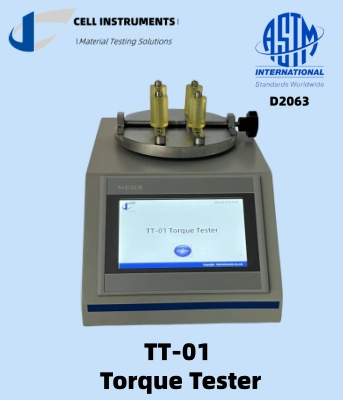
Um teste exato requer um stable and repeatable closure torque tester. Modern digital torque testers improve repeatability while simplifying operation. The Cell Instruments TT-01 torque tester supports ASTM D2063 testing by offering precise torque measurement, stable sample holding, and clear digital readouts.
Such features help laboratories:
- Reduce operator influence
- Improve test efficiency
- Maintain consistent documentation
When integrated into routine quality control, a dependable torque tester becomes an essential tool for packaging compliance.
Conclusão
ASTM D2063 provides a clear and structured framework for evaluating removal torque in continuous thread closure systems. By standardizing test methods, it helps packaging professionals verify torque retention, compare designs, and reduce packaging risks across storage and distribution environments.
With proper understanding of the test purpose, procedures, and applications—and with the support of accurate instruments like the Cell Instruments TT-01—manufacturers and laboratories can confidently apply ASTM D2063 to improve packaging performance and quality assurance.
 PT
PT  EN
EN  ES
ES  DE
DE  FR
FR  IT
IT  AR
AR  KO
KO  JA
JA  RU
RU  VI
VI  ID
ID  BG
BG  CS
CS  DA
DA  EL
EL  ET
ET  FI
FI  HE
HE  HU
HU  LT
LT  LV
LV  NL
NL  PL
PL  RO
RO  SK
SK  SV
SV  SL
SL  UK
UK  TR
TR