

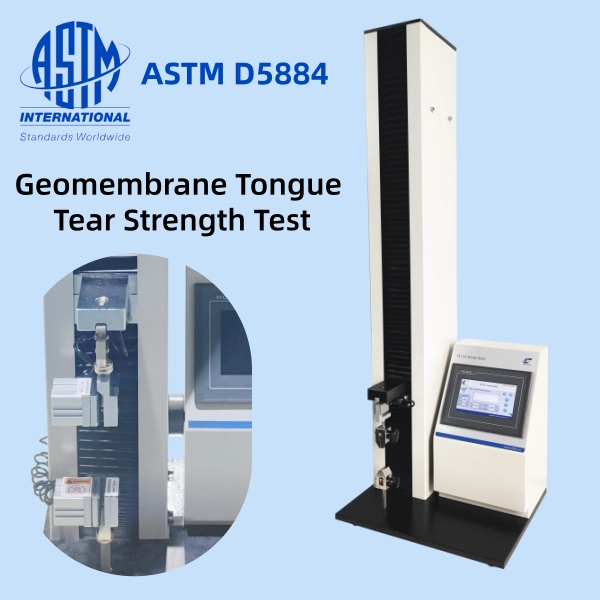
ASTM D5884
Geomembrane Tongue Tear Strength
ASTM D5884 defines a standardized procedure for evaluating the tearing strength of internally reinforced geomembranes. As reinforced membranes continue to play a critical role in waste containment, mining, water management, and environmental protection projects, engineers and quality-control teams rely on this standard to assess whether a material can resist tear propagation under real-world stresses.
Získat nabídkuGeomembranes Tearing Strength, Tongue Tear Method, Tensile Tear Strength
Testování geomembranes tearing strength helps engineers understand how a reinforced membrane behaves when mechanical stress initiates a tear. ASTM D5884 adopts the metoda trhání jazyka, which forces a controlled tear path to evaluate tensile tear strength as the cut propagates. Because different reinforcement structures behave differently under load, this method allows fair comparison across machine and cross-machine directions.
Purpose and Technical Importance of ASTM D5884
ASTM D5884 focuses on the material’s resistance to tear propagation, which is essential for predicting how a membrane handles handling stress, installation impact, or localized damage. Although tear resistance does not directly equal field durability, the method provides valuable insight into the relative toughness of reinforcement textiles.
Key uses include:
- Characterizing reinforcement efficiency
- Comparing performance between geomembrane designs
- Sledování konzistence výroby
- Supporting specification compliance and procurement decisions
By keeping test conditions uniform—cut geometry, strain rate, grip separation, and propagation distance—the standard minimizes external influences and improves test repeatability.
How the ASTM D5884 Test Works
A test specimen is prepared with a central slit, forming two tongues that pull apart during testing. The specimen is aligned carefully so the tear path remains consistent. The testing machine applies tension at 50 ± 2 mm/min, and the tear progresses across the specimen until failure.
The peak force recorded during propagation is defined as the tearing strength. ASTM D5884 requires:
- Five specimens in the machine direction
- Five specimens in the cross-machine direction
- Statistical outputs including average, standard deviation, and coefficient of variation
Any specimen that tears outside the intended cut path or deviates excessively from the sample mean must be replaced to maintain data integrity.
Key Factors Influencing Test Results
Accurate ASTM D5884 results depend on several controlled variables:
- Reinforcement type and density
- Membrane thickness
- Consistent strain rate
- Proper specimen cutting and alignment
- Grip stability and mechanical precision
A machine lacking stable displacement or accurate speed control may produce poor reproducibility. Therefore, laboratories benefit from professional-grade testing equipment.
Choosing the Right Tensile Tester from Cell Instruments
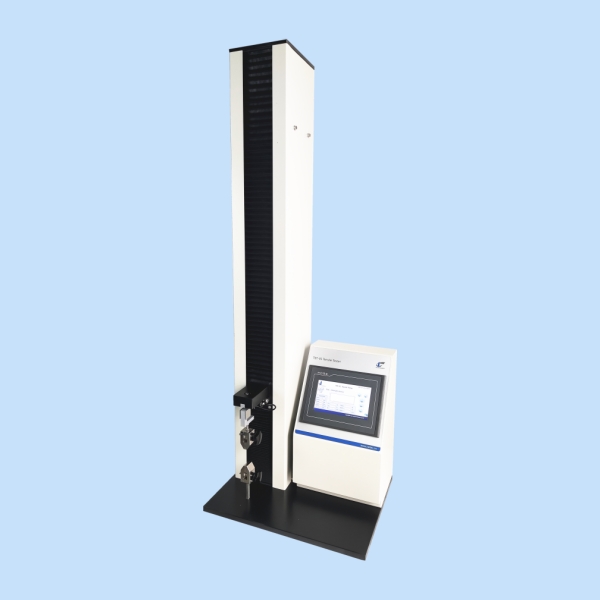
The Cell Instruments TST-01 Zkoušečka pevnosti v tahu provides the accuracy required for ASTM D5884. Its přesný kuličkový vodicí šroub, 0.01 mm displacement accuracya 1–500 mm/min speed range allow precise control of tear propagation. Reinforced geomembranes often require stable gripping and steady load distribution, and the TST-01 supports this through customizable fixtures and industrial-grade rigidity.
Additional advantages include:
- Křivky síla-posun v reálném čase
- Easy program setup for tear, peel, tensile, and puncture tests
- Reliable batch testing performance
- Quick fixture changeover for multi-material labs
This makes the TST-01 a strong solution for geomembrane manufacturers, QC labs, and research institutes that require dependable compliance with ASTM D5884 and other mechanical test standards.
FAQs about ASTM D5884
What does ASTM D5884 measure?ASTM D5884 measures the tearing strength of reinforced geomembranes using a controlled tongue tear method. It identifies the peak force required for a tear to propagate across a test specimen.
Why is tearing strength important for geomembranes?Tearing strength indicates how well a membrane resists localized damage. A material with high tear resistance is more reliable during installation, handling, and long-term environmental exposure.
What type of geomembranes apply to ASTM D5884?The method applies specifically to internally reinforced geomembranes, which incorporate textiles or scrims for enhanced mechanical strength.
What testing speed is required?ASTM D5884 requires the specimen to be pulled at 50 ± 2 mm/min to ensure consistent tear propagation and comparable results across laboratories.
How many specimens are needed?The standard requires pět exemplářů in each direction—machine and cross-machine—to calculate average tearing strength and variability.
What if the tear does not follow the cut path?The specimen must be discarded and replaced. An off-path tear suggests improper cutting, misalignment, or uneven reinforcement.
Which equipment is suitable for ASTM D5884?A tensile tester with stable displacement control, accurate speed, and proper gripping is essential. The Cell Instruments TST-01 is an excellent option due to its precision mechanics and configurable fixtures for tear testing.
Contact Us Get ASTM D5884 Testing Solution
ASTM D5884 provides a reliable framework for measuring the tearing strength of reinforced geomembranes using a controlled tongue tear method. The test helps manufacturers and quality-control teams understand how reinforcement textiles influence tear behavior, supporting material selection, product validation, and production monitoring. With precise equipment such as the Zkoušečka tahu TST-01, laboratories can achieve stable, repeatable results that meet international expectations in geomembrane performance evaluation.
 CS
CS  EN
EN  ES
ES  DE
DE  FR
FR  IT
IT  AR
AR  KO
KO  JA
JA  RU
RU  PT
PT  VI
VI  ID
ID  BG
BG  DA
DA  EL
EL  ET
ET  FI
FI  HE
HE  HU
HU  LT
LT  LV
LV  NL
NL  PL
PL  RO
RO  SK
SK  SV
SV  SL
SL  UK
UK  TR
TR