

Trapezoidal Tear Test for Fabric
Método de ensayo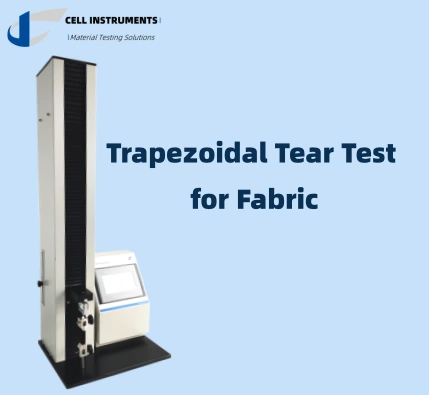
El prueba del desgarro trapezoidal is an essential method for evaluating the tearing strength of fabrics, providing manufacturers and quality control teams with reliable data on fabric durability and performance. By simulating real-world stresses, this test helps ensure that woven, knitted, layered, or coated fabrics meet required specifications. Cell Instruments offers advanced testing solutions, such as the Probador de tracción TST-01, to streamline and enhance testing accuracy.
ASTM D5587 and Tearing Strength of Fabrics by Trapezoid Procedure
El prueba del desgarro trapezoidal is a critical method for assessing the tensile strength of fabric. Conducted according to ASTM D5587, this test uses CRE type tensile testing machines to evaluate the tearing strength of fabrics by trapezoid procedure. It provides reliable and repeatable measurements across a wide range of textiles, including woven, knitted, layered, pile, and coated fabrics. The method is applicable for untreated or treated fabrics, and specimens may be tested in dry or wet conditions to simulate real-world use. By analyzing the force required to propagate a tear along a defined trapezoidal path, quality control teams can assess fabric durability, compare fabric types, and ensure consistency across commercial shipments.
Overview of the Trapezoidal Tear Test
The trapezoidal tear test is designed to initiate a tear in a rectangular specimen outlined with an isosceles trapezoid. The nonparallel sides of the trapezoid are clamped in the jaws of a CRE type tensile testing machine, and force is applied continuously to propagate the tear. Simultaneously, the force developed is recorded using an autographic chart or digital data collection system. The test is widely recognized for its precision and is frequently used in acceptance testing of commercial fabrics.
ASTM D5587 Test Procedure for Tensile Strength of Fabric
El ASTM D5587 standard outlines a precise methodology for assessing fabric tearing strength through the trapezoid procedure. Key aspects include:
Preparación de la muestra: Condition fabrics at 21 ± 1°C and 65 ± 2% relative humidity. Cut an isosceles trapezoid on the rectangular fabric sample and slit the smallest base to initiate the tear.
Clamping: Secure the nonparallel sides of the trapezoid in the jaws of a Máquina de ensayos de tracción tipo CRE, ensuring alignment and fold integrity.
Pruebas: Gradually increase the separation of the jaws to propagate the tear. Continuous measurement of force is recorded using autographic or digital data collection systems.
Resultados de la grabación: Identify the peak force required to maintain tear propagation. Typically, five specimens per principal direction are tested to ensure accuracy and repeatability.
This standardized procedure guarantees reliable assessment of the tensile strength of fabric while highlighting comparative performance across different materials or directions.
Tearing Strength of Fabrics by Trapezoid Procedure: Applications in Quality Control
The trapezoidal tear test is widely applied in:
Textile Manufacturing: Evaluate fabric durability for clothing, industrial textiles, and home furnishings.
Specialty Fabrics: Assess tear resistance of airbag fabrics, napped textiles, layered or coated fabrics.
Seguro de calidad: Confirm batch consistency and compliance for commercial shipments.
R&D Optimization: Compare fabric constructions, treatments, or coatings to improve material performance.
Benefits of Using Advanced Tensile Testers:
El Cell Instruments TST-01 Probador de tracción enhances the trapezoid tear procedure through:
Control preciso: PLC-driven system with 7″ HMI enables smooth, real-time curve monitoring.
Adjustable Speeds: Test rates from 1–500 mm/min accommodate various fabric types.
Versatile Fixtures: Rapid switching for tensile, peel, puncture, and tear testing.
Reliable Data Recording: Optional microprinter or RS-232 output ensures accurate and integrated reporting.
Industrial-Grade Construction: Stable platform ensures decades of consistent testing performance.
By integrating modern instruments like the TST-01, laboratories can minimize human error, improve efficiency, and achieve reproducible results for tearing strength of fabrics by trapezoid procedure.

A1: The trapezoidal tear test, as specified in ASTM D5587, applies to a wide range of fabrics including woven, knitted, napped, layered, pile, and coated or resin-treated fabrics. Both untreated and wet specimens can be tested, making it suitable for diverse textile applications.
Q2: Why is a CRE-type tensile testing machine preferred for this test?A2: CRE-type tensile machines provide a constant-rate-of-extension, ensuring consistent and accurate measurement of tearing strength. This allows precise propagation of the tear along the trapezoid specimen and reliable recording of peak force values for quality control and acceptance testing.
Q3: How does using the TST-01 Tensile Tester improve trapezoidal tear testing?A3: The Probador de tracción TST-01 enhances test accuracy, repeatability, and efficiency. Its PLC-driven control, real-time curve display, adjustable speeds, and versatile fixtures allow precise tearing tests for various fabrics. It also integrates data collection and reporting, minimizing human error and supporting research and
 ES
ES  EN
EN  DE
DE  FR
FR  IT
IT  AR
AR  KO
KO  JA
JA  RU
RU  PT
PT  VI
VI  ID
ID  BG
BG  CS
CS  DA
DA  EL
EL  ET
ET  FI
FI  HE
HE  HU
HU  LT
LT  LV
LV  NL
NL  PL
PL  RO
RO  SK
SK  SV
SV  SL
SL  UK
UK  TR
TR