

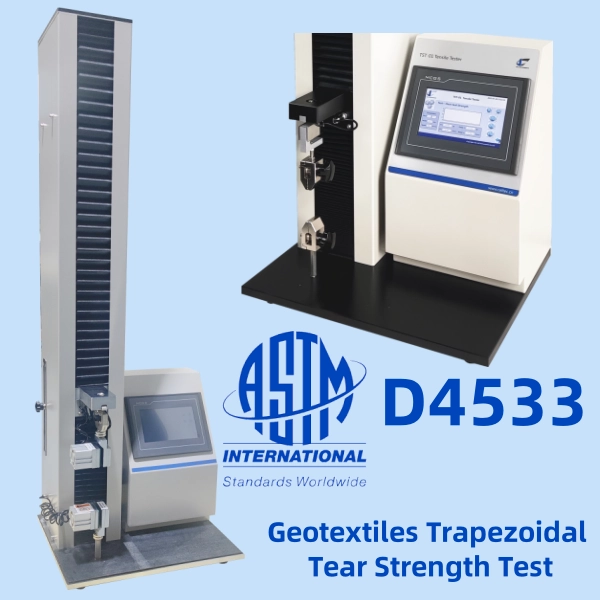
ASTM D4533
Geotextiles Trapezoidal Tear Strength Test
When assessing fabric tear strength for geotextiles, the standard method widely adopted is the ASTM D4533. This method, also known as the trapéz alakú szakítópróba, is used to measure the trapezoidal tearing strength test (also called the trapezoid tear test) of geotextiles or fabric-like materials.
AjánlatkérésWhy the test matters — geotextiles tear test relevance
Geotextiles are permeable textile materials used in soil, rock, earth or other geotechnical-engineering applications. The tear resistance of a geotextile can influence its performance under installation stress, handling, and long-term field loads. The trapezoid tearing strength test offers a standardized way to compare different geotextile materials or gauge directional differences in the same material.
ASTM D4533
According to the standard:
- The test method is an index teszt used to measure the force required to continue or propagate a tear in both woven and non-woven geotextiles by the trapezoid method.
- It is applicable to most geotextiles including woven fabrics, nonwovens, layered fabrics, knits, felts used in geotextile applications.
- The standard cautions that while useful for quality control and acceptance testing, the trapezoid tear test “does not provide all the information needed for all design applications.”
For your business, this means you can promote the capability of your tensile testing systems (like your customised tensile tester) for performing ASTM D4533 and highlight that for full design assessment, clients may need complementary test methods.
Trapezoidal Tear Strength Test Method of Geotextiles
Here’s how the trapezoid tearing strength test (trapezoid tear test) is carried out:
- A rectangular specimen of the geotextile is prepared and a template in the shape of an isosceles trapezoid is marked on it.
- A small cut (for example, a slit) is made at the short edge of the trapezoid to initiate the tear.
- The specimen is mounted in the testing machine so that the nonparallel sides of the trapezoid are clamped in parallel jaws. The short side (with the slit) is the end from which the tear will propagate.
- The machine pulls the jaws apart at a constant cross‐head speed (for example 300 ± 10 mm/min) and the force versus extension is recorded. The tearing propagates across the width of the specimen.
- A maximális erő recorded on the force-extension curve is reported as the trapezoid tearing strength.
In your promotional or technical literature, you can emphasise that your tensile tester supports the required constant-rate extension mode, appropriate grip sizes, jaw modification (if needed) and data acquisition for ASTM D4533 testing.
Choosing the Right Geotextiles Trapezoidal Tear Tester
At Cell Instruments, we specialise in materials testing instruments and customisation. For your trapezoid tearing strength tests, we can provide:
- Pontosság szakítóvizsgálók compatible with constant-rate-extension (CRE) mode and equipped with appropriate data acquisition for force–extension curves.
- Custom trapezoid tear grips: Jaws sized and configured to clamp the non-parallel sides of a trapezoid specimen reliably, no slippage.
- Automation options and high-throughput fixtures: useful when performing tens or hundreds of tear tests across batches or directions.
- Full service: from equipment supply through calibration, method setup, training and QA integration into your laboratory — spanning textiles, geotextiles, packaging, non-wovens, adhesive layers and more.
By aligning the instrument setup precisely with ASTM D4533 (and associated specimen preparation guidelines), your lab ensures reliable, comparable test data and supports high-quality output and specification compliance across your applications.
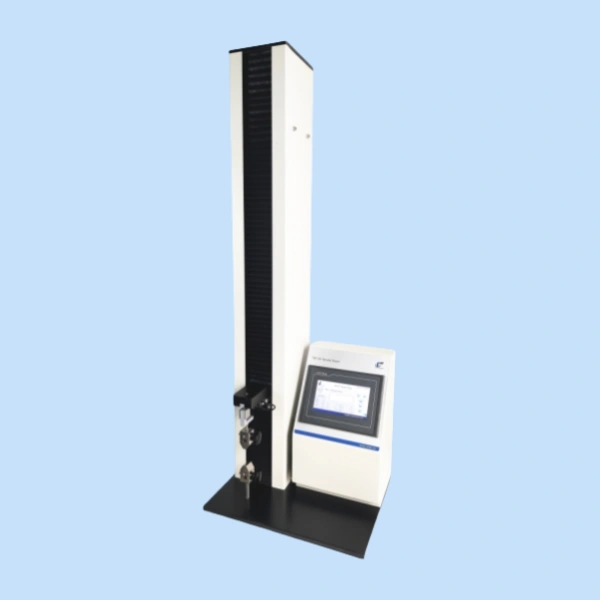
Contact Us Get ASTM D4533 Testing Solution
By aligning the instrument setup precisely with ASTM D4533 (and associated specimen preparation guidelines), your lab ensures reliable, comparable test data and supports high-quality output and specification compliance across your applications.
 HU
HU  EN
EN  ES
ES  DE
DE  FR
FR  IT
IT  AR
AR  KO
KO  JA
JA  RU
RU  PT
PT  VI
VI  ID
ID  BG
BG  CS
CS  DA
DA  EL
EL  ET
ET  FI
FI  HE
HE  LT
LT  LV
LV  NL
NL  PL
PL  RO
RO  SK
SK  SV
SV  SL
SL  UK
UK  TR
TR