
Loop Tack Test Method for Adhesive Performance Evaluation
Pressure-sensitive adhesives (PSAs) play a critical role in tapes, labels, medical dressings, and industrial bonding systems. Among the many performance indicators used to evaluate these materials, tack—the ability of an adhesive to quickly form a bond with light pressure—is particularly important.
The लूप टैक परीक्षण विधि is widely recognized as one of the most reliable techniques for measuring the instantaneous adhesion of pressure-sensitive materials. By quantifying the maximum force required to detach an adhesive loop from a standardized surface, the test provides a clear and repeatable measurement of adhesive tack.
Loop Tack Testing: Measuring Instant Adhesion Performance
Loop tack testing evaluates how quickly and strongly a pressure-sensitive adhesive bonds to a substrate when minimal pressure is applied. The test involves forming a loop of adhesive tape with the adhesive surface facing outward and bringing it into controlled contact with a stainless-steel surface.
When the loop contacts the substrate, only the weight of the specimen itself provides the bonding pressure. The test instrument then separates the loop from the substrate while recording the maximum force required for detachment.
Key characteristics measured during loop tack testing include:
- Initial adhesion strength
- Adhesive bonding speed
- Consistency of adhesive formulation
- Failure mode behavior (adhesion, cohesion, or transfer)
Because the contact pressure remains minimal and controlled, loop tack testing provides a reliable indicator of how an adhesive performs during real-world application.
Pressure Sensitive Tape Loop Tack Evaluation
The pressure sensitive tape loop tack test is especially important for industries where rapid adhesion is required. These include:
- Packaging tapes
- Pressure-sensitive labels
- Medical adhesive tapes
- Protective films
- Industrial bonding materials
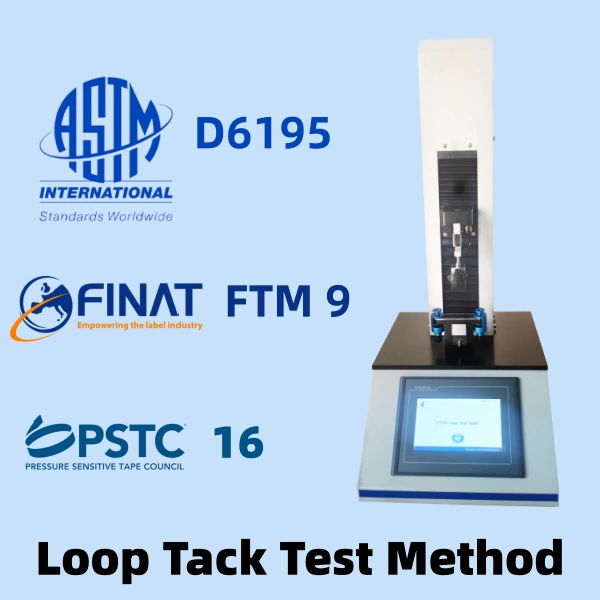
Loop Tack Standard – PSTC-16 & ASTM D6195 & FINAT FTM 9
पीएसटीसी-16 Loop Tack Standard
पीएसटीसी-16 is a test method developed by the Pressure Sensitive Tape Council to evaluate the tack performance of pressure-sensitive adhesives. The method measures how quickly an adhesive forms a bond immediately after brief contact with another surface.
Basic Testing Principle
In the test, an adhesive strip is folded into a teardrop-shaped loop with the adhesive facing outward. The loop lightly contacts a 1 square inch stainless steel surface, where the only applied pressure comes from the weight of the adhesive specimen itself.
The testing instrument then separates the loop from the surface and records the maximum force required to break the bond, which represents the loop tack value.
Key Test Configurations
PSTC-16 specifies two measurement approaches:
- Method A: using a tensile tester with a 175 mm specimen strip
- Method B: using a dedicated loop tack tester के साथ 125 mm specimen strip
This standard is widely used for quality control and adhesive performance comparison in tape and label manufacturing.
एएसटीएम डी6195 लूप टैक परीक्षण विधि
एएसटीएम डी6195 provides standardized procedures for measuring the loop tack of pressure-sensitive adhesive products, including tapes, labels, and laminates. The method quantifies the instant adhesion force generated when the adhesive briefly contacts a test surface.
Testing Concept
A specimen strip with adhesive backing is shaped into a loop and brought into controlled contact with a stainless steel panel measuring 25 mm × 25 mm.
After contact occurs, the testing machine immediately pulls the loop away from the panel and records the peak force required for separation.
Equipment Options
ASTM D6195 allows two testing configurations:
- Tensile tester method using a universal testing machine and loop fixture
- Loop tack tester method using a dedicated instrument designed specifically for tack measurement
The standard provides a reliable quantitative measurement of adhesive tack, making it suitable for research, product development, and routine quality control.
फिनाट एफटीएम 9
फिनाट एफटीएम 9 is part of the FINAT Technical Manual used widely in the self-adhesive label industry. The method evaluates the “initial grab” or application tack of pressure-sensitive laminates, which is critical for processes such as automatic labeling.
Measurement Principle
The adhesive strip is formed into a loop with the adhesive surface facing outward and mounted on a tensile tester. The loop contacts a glass test plate (approximately 25 mm × 25 mm) and is then separated at a controlled speed of 300 mm/min.
The force required to detach the loop from the surface represents the loop tack value.
Test Conditions and Results
Typical test conditions are 23 °C ±2 °C and 50 % RH ±5 %. At least पाँच नमूने are tested, and the average force in Newtons is reported.
Additional observations such as adhesive transfer (AT) या paper tear (PT) may also be recorded to describe the failure mode.
| मानक | Loop Length | Surface Area | Key Notes |
|---|---|---|---|
| पीएसटीसी-16 | 125 mm or 175 mm | 24 mm × 24 mm | Two test methods (tensile tester or loop tack tester) |
| एएसटीएम डी6195 | 125 mm (Method B) or 175 mm (Method A) | 25 mm × 25 mm | Widely used in U.S. testing labs |
| फिनाट एफटीएम 9 | 175 mm | 25 mm × 25 mm (glass) | Preferred in Europe for label adhesives |
 HI
HI  EN
EN  ES
ES  DE
DE  FR
FR  IT
IT  AR
AR  KO
KO  JA
JA  RU
RU  PT
PT  VI
VI  ID
ID  BG
BG  CS
CS  DA
DA  EL
EL  ET
ET  FI
FI  HE
HE  HU
HU  LT
LT  LV
LV  NL
NL  PL
PL  RO
RO  SK
SK  SV
SV  SL
SL  UK
UK  TR
TR  BE
BE  BS
BS  HR
HR  KK
KK  ML
ML  MY
MY  NN
NN  SR
SR  TA
TA  UZ
UZ  SQ
SQ