

Tensile Strength Test for Geomembranes: ASTM D6693 Guide
Các Thử nghiệm độ bền kéo cho màng địa kỹ thuật plays a critical role in evaluating how geomembrane materials respond to tensile forces during installation and service. Tiêu chuẩn ASTM D6693 provides a standardized framework that helps laboratories and quality control personnel generate consistent tensile and elongation data for nonreinforced geomembranes.
Unlike design-oriented performance tests, ASTM D6693 functions as an index method. Its value lies in repeatability, comparability, and clear guidance on how to conduct tests and calculate results. This article focuses specifically on the test procedure and computational aspects, enabling readers to understand not only what to measure, but also how to complete the test correctly.
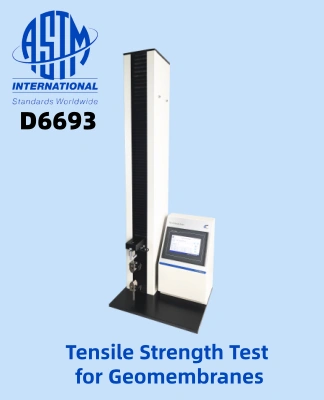
Geomembranes as Tensile Test Materials
Geomembranes used in tensile testing are typically nonreinforced polymer sheets, including polyethylene and flexible polypropylene products. These materials demonstrate nonlinear mechanical behavior, meaning their response to tensile loading changes as deformation increases. Because of this behavior, the Tensile Strength Test for Geomembranes focuses not only on maximum load but also on how the material elongates under stress.
ASTM D6693 applies to geomembranes within a broad thickness range, covering most commercial products used in civil and environmental engineering. Standard dumbbell-shaped specimens help minimize stress concentration and improve repeatability. Consistent specimen preparation remains essential, as thickness variation, surface texture, and handling can influence tensile results.
ASTM D6693 Elongation Testing Machine
ASTM D6693 defines how elongation in tensile test measurements should be obtained using a calibrated elongation testing machine operating at a constant crosshead speed. Instead of relying on extensometers, the method uses crosshead displacement as an index of elongation. This approach prioritizes repeatability and practicality for quality control rather than theoretical strain accuracy.
The standard specifies test speed, conditioning requirements, and alignment principles to reduce variability. By controlling these parameters, ASTM D6693 allows laboratories to generate tensile strength and elongation data that reflect material consistency and manufacturing quality.
Specimen Preparation and Test Setup
Accurate results in the Tensile Strength Test for Geomembranes begin with proper specimen preparation. Dumbbell-shaped specimens are cut according to standardized dimensions to ensure uniform stress distribution during loading. Before testing, operators measure specimen width and thickness using appropriate methods for smooth or textured geomembranes.
Specimens must be conditioned under controlled environmental conditions to reduce variability. During setup, careful alignment of the specimen with the grips of the elongation testing machine ensures that tensile force acts along the central axis. Even grip pressure prevents slippage without damaging the specimen, which is critical for reliable elongation data.
Step-by-Step Tensile Strength Test Procedure
Once preparation is complete, the test procedure follows a logical sequence designed to minimize experimental error:
Mounting the specimen
Place the specimen centrally in the grips, ensuring correct gauge length and axial alignment.Setting test speed
Adjust the elongation testing machine to the specified crosshead speed defined by ASTM D6693. Speed consistency directly affects elongation in tensile test results.Initiating the test
Start the machine and apply tensile load continuously until rupture occurs.Recording the load–extension curve
Capture the full load and extension response throughout the test. This curve forms the basis for all subsequent calculations.Identifying key points
Record load and extension values at the yield point, when present, and at the break point.
Multiple specimens are tested to ensure statistical relevance. For anisotropic materials, testing in different orientations helps capture directional behavior.
Computational Method for Tensile Results
ASTM D6693 defines clear calculation methods to convert raw test data into meaningful tensile properties. These calculations link measured force and extension to standardized reporting values.
Tensile break strength is calculated by dividing the maximum load at rupture by the original minimum width of the specimen. This approach normalizes strength data and allows comparison between materials of different dimensions.
Elongation in tensile test results are expressed as percentages. Percent elongation at break is calculated by dividing the extension at rupture by the defined gauge length, then multiplying by 100. This value reflects the material’s deformation capacity under tensile loading.
When a yield point exists, percent yield elongation may also be calculated using the same principle. Consistent gauge length usage is critical, as it directly affects elongation values.
Role of the Elongation Testing Machine in ASTM D6693
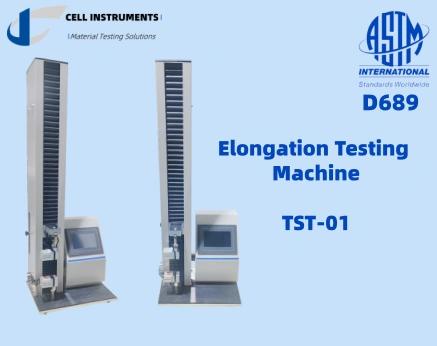
Reliable execution of the Tensile Strength Test for Geomembranes depends on stable load measurement and precise crosshead control. The Dụng cụ tế bào Tensile Tester TST-01 supports ASTM D6693 testing by providing accurate force sensing, controlled test speed, and clear data acquisition.
For laboratories focused on routine quality control, the TST-01 offers flexibility across geomembrane types while maintaining compliance with standardized procedures. Its configuration supports consistent elongation in tensile test measurement without unnecessary complexity.
Phần kết luận
Các Thử nghiệm độ bền kéo cho màng địa kỹ thuật under ASTM D6693 delivers practical, repeatable insight into tensile behavior through well-defined procedures and calculations. By understanding specimen preparation, step-by-step testing, and result computation, quality professionals can perform tests with confidence and interpret elongation and strength data correctly.
When paired with a reliable elongation testing machine such as the Cell Instruments TST-01, ASTM D6693 becomes an efficient and dependable tool for geomembrane quality assurance and specification conformance.
Câu hỏi thường gặp
How many specimens are required for reliable results?For isotropic geomembranes, at least five specimens are tested. For anisotropic materials, testing typically includes specimens in different directions. Multiple specimens improve statistical reliability and help identify variability in tensile properties.
Why is elongation in tensile test important for geomembranes?Elongation in tensile test indicates how much a geomembrane can deform before rupture. This property is critical because geomembranes often experience stretching during installation, welding, anchoring, and long-term service. High elongation at break generally reflects better adaptability to field stresses.
How are tensile break strength and elongation calculated?Tensile break strength is calculated by dividing the maximum load at rupture by the original minimum width of the specimen. Elongation at break is calculated by dividing the extension at rupture by the defined gauge length and multiplying by 100 to obtain a percentage.
 VI
VI  EN
EN  ES
ES  DE
DE  FR
FR  IT
IT  AR
AR  KO
KO  JA
JA  RU
RU  PT
PT  ID
ID  BG
BG  CS
CS  DA
DA  EL
EL  ET
ET  FI
FI  HE
HE  HU
HU  LT
LT  LV
LV  NL
NL  PL
PL  RO
RO  SK
SK  SV
SV  SL
SL  UK
UK  TR
TR