
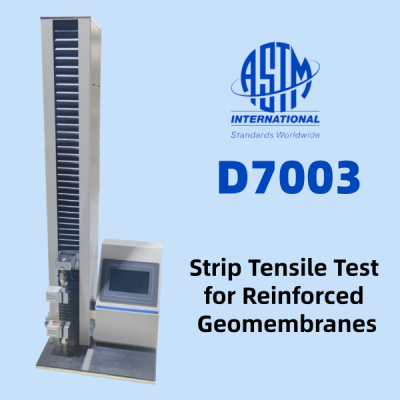
ASTM D7003 define un método normalizado para evaluar la propiedades de tracción en banda de las geomembranas reforzadas, que se utilizan ampliamente en sistemas de contención medioambiental como vertederos, embalses y explotaciones mineras. Estos materiales combinan láminas de polímero con refuerzo textil, lo que hace que su comportamiento a la tracción sea más complejo que el de las láminas convencionales.
Este método se centra en control de calidad (CC), garantía de calidad (GC) y aplicaciones de investigación en lugar del diseño estructural. Hace hincapié en las pruebas a lo largo de las direcciones de refuerzo para reflejar con precisión el rendimiento del material.
Entre los resultados clave de la norma ASTM D7003 se incluyen:
- Resistencia máxima a la tracción (kN/m)
- Alargamiento con carga máxima (%)
- Carga y alargamiento a la rotura final
- Coherencia estadística (media y desviación típica)
Ensayo de tracción en banda de la geomembrana
El ensayo de tracción de tiras de geomembrana según la norma ASTM D7003 mide cómo responden las geomembranas reforzadas a las fuerzas de tracción uniaxiales. A diferencia de los ensayos de tracción de gran anchura, este método aísla los filamentos de refuerzo específicos dentro de una probeta estrecha.
Preparación de las muestras
- Anchura: 25 mm (1 pulgada)
- Longitud: ≥150 mm (6 pulgadas)
- Orientación: Paralela a la dirección del refuerzo (MD o TD)
- Cantidad: Mínimo 5 muestras por dirección
Un requisito fundamental es que los hilos de refuerzo deben permanecer continuos entre los agarres. Cualquier interrupción reduce significativamente la potencia medida y compromete la validez de los datos.
Procedimiento de ensayo de tracción en banda
El procedimiento de ensayo de tracción en banda en ASTM D7003 sigue una secuencia precisa para garantizar resultados fiables:
Procedimiento paso a paso
- Ajustar la longitud del calibre
Ajuste la separación de la empuñadura a 75 mm (3 pulgadas). - Montar el espécimen
Alinee la probeta centrada, asegurándose de que la dirección de la carga coincide con la orientación del refuerzo. - Aplicar carga de tracción
Extender la probeta a una velocidad constante de 300 mm/min hasta el fracaso. - Controlar el comportamiento
Registre el curva carga-extensión continuamente. - Validar resultados
Descarta los resultados si:- Se producen deslizamientos
- La rotura se produce en las empuñaduras
- El refuerzo se arranca sin romperse
- Repetición de pruebas
Realice ensayos para todas las muestras en ambas direcciones.
Datos clave registrados
- Carga máxima
- Separación del agarre en carga máxima
- Carga en la rotura final
- Alargamiento en la rotura final
Ensayo de alargamiento de la geomembrana
El ensayo de alargamiento de geomembranas determina cuánto se estira una probeta antes de fallar, lo que proporciona información sobre la ductilidad y la eficacia del refuerzo.
Cálculo del alargamiento
Alargamiento (%)=75ΔL×100
Dónde:
- ΔL = desplazamiento de agarre (mm)
- 75 mm = longitud de galga inicial
Interpretación
- Baja elongación → refuerzo rígido y de alta resistencia.
- Alta elongación → estructura flexible, mejor tolerancia a la deformación
Ambos valores son esenciales para evaluar rendimiento en condiciones de estrés sobre el terreno, especialmente en los sistemas de contención.
Recomendación de equipos para los ensayos ASTM D7003
La ejecución precisa de la norma ASTM D7003 requiere una sistema de ensayo de tracción de alta precisión. En Cell Instruments TST-01 Probador de tracción es especialmente adecuado para esta aplicación.
¿Por qué elegir el TST-01?
- Control PLC estable con interfaz HMI garantiza una gestión precisa de las pruebas
- Amplia gama de velocidades (1-500 mm/min) cumple fácilmente el requisito de 300 mm/min
- Gran precisión de desplazamiento (±0,01 mm) permite una medición precisa del alargamiento
- Accesorios personalizables alojar muestras de geomembrana
- Visualización de curvas en tiempo real mejora el análisis de datos
Garantice ensayos precisos y conformes a la norma ASTM D7003 con soluciones avanzadas de ensayos de tracción. El equipo adecuado permite medir con precisión la resistencia a la tracción y el alargamiento, ayudándole a mantener la calidad del producto y a cumplir las normas internacionales. Cell Instruments ofrece sistemas fiables y personalizables diseñados para aplicaciones de ensayos de geomembranas. Optimice su flujo de trabajo de ensayos, mejore la coherencia de los datos y refuerce su proceso de garantía de calidad con tecnología de ensayos de tracción de calidad profesional.
Preguntas frecuentes sobre ASTM D7003
1. ¿Para qué se utiliza la norma ASTM D7003?
Evalúa las propiedades de tracción de las geomembranas reforzadas con fines de control de calidad, aseguramiento de la calidad e investigación.
2. ¿Por qué las probetas deben alinearse con la dirección de la armadura?
Dado que la resistencia a la tracción depende en gran medida de la orientación de la armadura, la desalineación conduce a resultados inexactos.
3. ¿Qué ocurre si los hilos no son continuos?
La resistencia a la tracción medida disminuye significativamente, lo que invalida el resultado.
4. Es ASTM D7003 adecuado para los cálculos de diseño?
No, es una prueba de índice y no debe utilizarse directamente para el diseño de ingeniería.
5. ¿Cuál es la velocidad de prueba estándar?
La velocidad de cruceta requerida es de 300 mm/min.
6. ¿Cómo se calcula la resistencia a la tracción?
Dividiendo la carga máxima por la anchura de la probeta, expresada en kN/m.
 ES
ES  EN
EN  DE
DE  FR
FR  IT
IT  AR
AR  KO
KO  JA
JA  RU
RU  PT
PT  VI
VI  ID
ID  BG
BG  CS
CS  DA
DA  EL
EL  ET
ET  FI
FI  HE
HE  HU
HU  LT
LT  LV
LV  NL
NL  PL
PL  RO
RO  SK
SK  SV
SV  SL
SL  UK
UK  TR
TR  BE
BE  BS
BS  HI
HI  HR
HR  KK
KK  ML
ML  MY
MY  NN
NN  SR
SR  TA
TA  UZ
UZ  SQ
SQ  TH
TH