
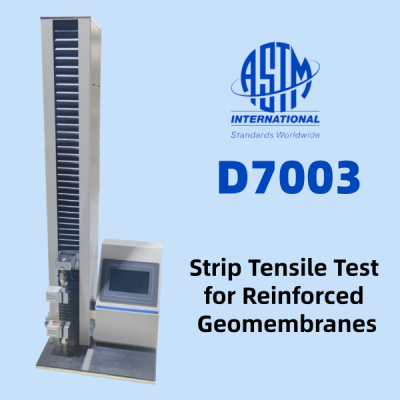
ASTM D7003 defines a standardized method to evaluate the strip tensile properties of reinforced geomembranes, which are widely used in environmental containment systems such as landfills, reservoirs, and mining operations. These materials combine polymer sheets with textile reinforcement, making their tensile behavior more complex than conventional films.
This method focuses on quality control (QC), quality assurance (QA), and research applications rather than structural design. It emphasizes testing along reinforcement directions to accurately reflect material performance.
Key outcomes of ASTM D7003 include:
- Peak tensile strength (kN/m)
- Elongation at peak load (%)
- Load and elongation at final break
- Statistical consistency (average and standard deviation)
Strip Tensile Test of Geomembrane
The strip tensile test of geomembrane under ASTM D7003 measures how reinforced geomembranes respond to uniaxial tensile forces. Unlike wide-width tensile tests, this method isolates specific reinforcement strands within a narrow specimen.
Specimen Preparation
- Width: 25 mm (1 inch)
- Length: ≥150 mm (6 inches)
- Orientation: Parallel to reinforcement direction (MD or TD)
- Quantity: Minimum 5 specimens per direction
A critical requirement is that reinforcing yarns must remain continuous between grips. Any interruption significantly reduces measured strength and compromises data validity.
Strip Tensile Test Procedure
The strip tensile test procedure in ASTM D7003 follows a precise sequence to ensure reliable results:
Step-by-Step Procedure
- Set Gauge Length
Adjust grip separation to 75 mm (3 inches). - Mount Specimen
Align the specimen centrally, ensuring the load direction matches reinforcement orientation. - Apply Tensile Load
Extend the specimen at a constant speed of 300 mm/min until failure. - Monitor Behavior
Record the load-extension curve continuously. - Validate Results
Discard results if:- Slippage occurs
- Break happens at grips
- Reinforcement pulls out without breaking
- Repeat Testing
Conduct tests for all specimens in both directions.
Key Recorded Data
- Peak load
- Grip separation at peak load
- Load at final break
- Elongation at final break
Geomembrane Elongation Test
The geomembrane elongation test determines how much a specimen stretches before failure, providing insight into ductility and reinforcement efficiency.
Elongation Calculation
Elongation (%)=75ΔL×100
Where:
- ΔL = grip displacement (mm)
- 75 mm = initial gauge length
Interpretation
- Low elongation → stiff, high-strength reinforcement
- High elongation → flexible structure, better deformation tolerance
Both values are essential for evaluating performance under field stress conditions, especially in containment systems.
Equipment Recommendation for ASTM D7003 Testing
Accurate execution of ASTM D7003 requires a high-precision tensile testing system. The Cell Instruments TST-01 Tensile Tester is particularly suitable for this application.
Why Choose TST-01?
- Stable PLC control with HMI interface ensures precise test management
- Wide speed range (1–500 mm/min) easily meets the 300 mm/min requirement
- High displacement accuracy (±0.01 mm) supports precise elongation measurement
- Customizable fixtures accommodate geomembrane specimens
- Real-time curve display enhances data analysis
Ensure precise and compliant ASTM D7003 testing with advanced tensile testing solutions. The right equipment enables accurate measurement of tensile strength and elongation, helping you maintain product quality and meet international standards. Cell Instruments offers reliable, customizable systems designed for geomembrane testing applications. Optimize your testing workflow, improve data consistency, and strengthen your quality assurance process with professional-grade tensile testing technology.
FAQs about ASTM D7003
1. What is ASTM D7003 used for?
It evaluates the tensile properties of reinforced geomembranes for QC, QA, and research purposes.
2. Why must specimens align with reinforcement direction?
Because tensile strength depends heavily on reinforcement orientation, misalignment leads to inaccurate results.
3. What happens if yarns are not continuous?
The measured tensile strength decreases significantly, making the result invalid.
4. Is ASTM D7003 suitable for design calculations?
No, it is an index test and should not be used directly for engineering design.
5. What is the standard test speed?
The required crosshead speed is 300 mm/min.
6. How is tensile strength calculated?
By dividing the maximum load by specimen width, expressed in kN/m.
 NN
NN  EN
EN  ES
ES  DE
DE  FR
FR  IT
IT  AR
AR  KO
KO  JA
JA  RU
RU  PT
PT  VI
VI  ID
ID  BG
BG  CS
CS  DA
DA  EL
EL  ET
ET  FI
FI  HE
HE  HU
HU  LT
LT  LV
LV  NL
NL  PL
PL  RO
RO  SK
SK  SV
SV  SL
SL  UK
UK  TR
TR  BE
BE  BS
BS  HI
HI  HR
HR  KK
KK  ML
ML  MY
MY  SR
SR  TA
TA  UZ
UZ  SQ
SQ  TH
TH