
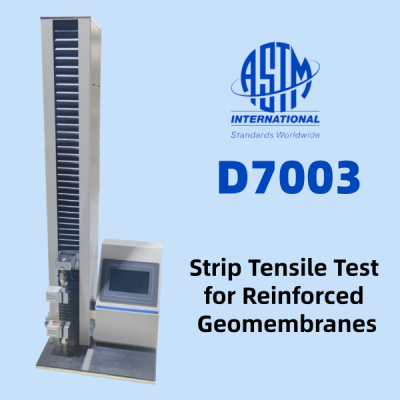
ASTM D7003 definește o metodă standardizată de evaluare a proprietățile la tracțiune ale geomembranelor armate, care sunt utilizate pe scară largă în sistemele de reținere a mediului, cum ar fi depozitele de deșeuri, rezervoarele și operațiunile miniere. Aceste materiale combină foi de polimer cu armături textile, ceea ce face ca comportamentul lor la tracțiune să fie mai complex decât cel al filmelor convenționale.
Această metodă se concentrează pe controlul calității (QC), asigurarea calității (QA) și aplicații de cercetare mai degrabă decât proiectarea structurală. Acesta pune accentul pe testarea de-a lungul direcțiilor de armare pentru a reflecta cu exactitate performanța materialului.
Principalele rezultate ale ASTM D7003 includ:
- Rezistența maximă la tracțiune (kN/m)
- Alungire la sarcină maximă (%)
- Sarcina și alungirea la ruperea finală
- Consistență statistică (medie și abatere standard)
Test de tracțiune la bandă a geomembranei
The test de tracțiune la bandă a geomembranei conform ASTM D7003 măsoară modul în care geomembranele armate răspund la forțe de tracțiune uniaxiale. Spre deosebire de testele de tracțiune pe lățime mare, această metodă izolează anumite fire de armătură în cadrul unui specimen îngust.
Pregătirea specimenului
- Lățime: 25 mm (1 inch)
- Lungime: ≥150 mm (6 inch)
- Orientare: Paralelă cu direcția de întărire (MD sau TD)
- Cantitate: Minim 5 specimene pe direcție
O cerință esențială este ca firele de armare trebuie să rămână continue între mânere. Orice întrerupere reduce semnificativ puterea măsurată și compromite validitatea datelor.
Procedura de testare la tracțiune a benzii
The procedura de încercare la tracțiune a benzilor în ASTM D7003 urmează o secvență precisă pentru a asigura rezultate fiabile:
Procedură pas cu pas
- Setați lungimea calibrului
Reglați separarea mânerului la 75 mm (3 inci). - Montați specimenul
Aliniați epruveta central, asigurându-vă că direcția sarcinii coincide cu orientarea armăturii. - Aplicați sarcina de tracțiune
Extindeți specimenul la o viteză constantă de 300 mm/min până la eșec. - Monitorizarea comportamentului
Înregistrați curba sarcină-extensie continuu. - Validarea rezultatelor
Aruncați rezultatele dacă:- Se produc alunecări
- Ruperea se produce la mânere
- Armătura se extrage fără a se rupe
- Repetarea testelor
Efectuați teste pentru toate probele în ambele direcții.
Date cheie înregistrate
- Sarcină de vârf
- Separarea aderenței la sarcină maximă
- Sarcina la pauza finală
- Alungirea la ruperea finală
Test de alungire a geomembranelor
The testul de alungire a geomembranelor determină cât de mult se întinde o probă înainte de rupere, oferind informații despre ductilitate și eficiența armăturii.
Calculul alungirii
Alungire (%)=75ΔL×100
Unde:
- ΔL = deplasarea prinderii (mm)
- 75 mm = lungimea inițială a gabaritului
Interpretare
- Alungire redusă → armătură rigidă, de înaltă rezistență
- Alungire ridicată → structură flexibilă, toleranță mai bună la deformare
Ambele valori sunt esențiale pentru evaluarea performanță în condiții de stres pe teren, în special în sistemele de reținere.
Recomandare privind echipamentul pentru testarea ASTM D7003
Executarea corectă a ASTM D7003 necesită o sistem de testare la tracțiune de înaltă precizie. The Cell Instruments TST-01 Tester de tracțiune este deosebit de potrivit pentru această aplicație.
De ce să alegeți TST-01?
- Control PLC stabil cu interfață HMI asigură gestionarea precisă a testelor
- Gamă largă de viteze (1-500 mm/min) îndeplinește cu ușurință cerința de 300 mm/min
- Precizie ridicată a deplasării (±0,01 mm) sprijină măsurarea precisă a alungirii
- Corpuri personalizabile acomodarea specimenelor de geomembrane
- Afișarea curbei în timp real îmbunătățește analiza datelor
Asigurați testarea precisă și conformă ASTM D7003 cu soluții avansate de testare la tracțiune. Echipamentul potrivit permite măsurarea precisă a rezistenței la tracțiune și a alungirii, ajutându-vă să mențineți calitatea produselor și să respectați standardele internaționale. Cell Instruments oferă sisteme fiabile, personalizabile, concepute pentru aplicații de testare a geomembranelor. Optimizați fluxul de testare, îmbunătățiți consistența datelor și consolidați procesul de asigurare a calității cu tehnologia de testare la tracțiune de nivel profesional.
Întrebări frecvente despre ASTM D7003
1. Pentru ce este utilizat ASTM D7003?
Acesta evaluează proprietățile la tracțiune ale geomembranelor armate în scopuri de QC, QA și cercetare.
2. De ce trebuie ca specimenele să se alinieze cu direcția armăturii?
Deoarece rezistența la tracțiune depinde în mare măsură de orientarea armăturii, alinierea greșită conduce la rezultate inexacte.
3. Ce se întâmplă dacă firele nu sunt continue?
Rezistența la tracțiune măsurată scade semnificativ, ceea ce face ca rezultatul să nu fie valabil.
4. Este ASTM D7003 adecvate pentru calculele de proiectare?
Nu, este un test index și nu ar trebui utilizat direct pentru proiectarea tehnică.
5. Care este viteza standard de testare?
Viteza necesară a capului transversal este de 300 mm/min.
6. Cum se calculează rezistența la tracțiune?
Prin împărțirea sarcinii maxime la lățimea probei, exprimată în kN/m.
 RO
RO  EN
EN  ES
ES  DE
DE  FR
FR  IT
IT  AR
AR  KO
KO  JA
JA  RU
RU  PT
PT  VI
VI  ID
ID  BG
BG  CS
CS  DA
DA  EL
EL  ET
ET  FI
FI  HE
HE  HU
HU  LT
LT  LV
LV  NL
NL  PL
PL  SK
SK  SV
SV  SL
SL  UK
UK  TR
TR  BE
BE  BS
BS  HI
HI  HR
HR  KK
KK  ML
ML  MY
MY  NN
NN  SR
SR  TA
TA  UZ
UZ  SQ
SQ  TH
TH