
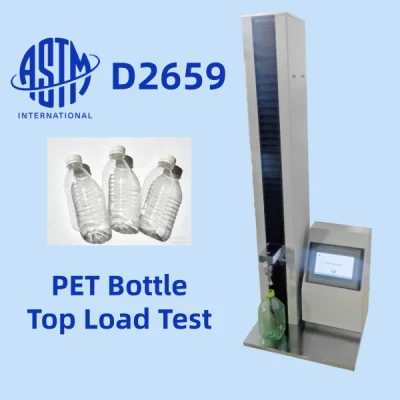
ASTM D2659 focuses on column crush testing under a constant rate of compressive deflection. Although it was originally developed for blow-molded containers, the procedure also applies to containers made by thermoforming or injection molding, provided the geometry allows proper alignment and loading.
The standard evaluates how a container resists vertical compression along its central axis. This loading condition closely reflects real-world stresses during pallet stacking or conveyor accumulation. Because of this relevance, ASTM D2659 has become a benchmark method in PET bottle quality control and R&D.
Why ASTM D2659 Matters for PET Bottle Quality Control
ASTM D2659 does not attempt to simulate every real-life condition. Instead, it provides comparable and repeatable data under defined laboratory conditions. According to the standard, column crush results support:
- Research and development, such as lightweighting PET bottles
- Design evaluation, comparing different container geometries
- Quality control, ensuring batch-to-batch consistency
- Acceptance or rejection under technical specifications
It is important to note that results obtained under ASTM D2659 apply only to similar load-time conditions. When containers experience long-term loads or impacts, additional tests like creep or impact testing should supplement the column crush data.
Key Mechanical Properties Defined in ASTM D2659
ASTM D2659 specifies several important parameters that describe column crush behavior:
- Crushing yield load – the load at which deflection increases without a corresponding increase in force
- Deflection at crushing yield load – the vertical deformation at the yield point
- Crushing load at failure – the maximum load before fracture or collapse, when applicable
- Apparent crushing stiffness – the slope of the initial linear portion of the load–deflection curve
Brittle materials often fail suddenly, making the crushing yield load equivalent to the failure load. Ductile PET containers typically show a clear yield region, which provides valuable insight into design robustness.
Testing Speed and Its Influence on Results
ASTM D2659 strictly defines the speed of testing, as testing speed directly affects measured crush properties. The standard specifies:
- A constant speed within ±10% variation
- An acceptable range of 12.5 to 50 mm/min
- A commonly used reference speed of 25 ± 2.5 mm/min
Round-robin studies cited in ASTM D2659 show reduced precision outside this range. For new PET bottle designs, testing at multiple speeds often reveals how strain rate influences performance, which is particularly valuable during packaging optimization.
Top Load Testing Procedure and Data Collection
During ASTM D2659 testing, the operator places the specimen between the platens and applies compressive load at the selected speed. Proper venting of the container is essential to avoid internal pressure buildup, which can affect accuracy and safety.
When full characterization is required, the test records a load–deflection curve until yield or failure. This curve allows calculation of stiffness and identification of structural transitions. For routine quality control, some users focus only on crushing yield load, which still provides a strong indicator of container consistency.
Interpreting Results for Quality Control and Design
ASTM D2659 data support multiple objectives, including:
- Comparing bottle designs or resin grades
- Monitoring production stability across molding batches
- Establishing acceptance or rejection criteria
- Supporting R&D optimization of lightweight containers
The standard emphasizes that results apply only to conditions similar to the test setup. For applications involving long-term loading or dynamic stress, complementary tests such as creep or impact remain necessary.
Choosing the Right Equipment for ASTM D2659 Testing
Reliable execution of ASTM D2659 depends on precise force, displacement, and speed control. The Cell Instruments TLT-01 Top Load Tester supports column crush and top load testing by providing stable compression, accurate displacement measurement, and flexible speed settings across and beyond the ASTM D2659 range. Its vertical loading principle matches the standard’s requirements while accommodating different PET bottle heights and diameters.
For laboratories seeking repeatable PET bottle compression test results, such equipment helps translate ASTM D2659 from a written standard into consistent, auditable data.
 EN
EN  ES
ES  DE
DE  FR
FR  IT
IT  AR
AR  KO
KO  JA
JA  RU
RU  PT
PT  VI
VI  ID
ID  BG
BG  CS
CS  DA
DA  EL
EL  ET
ET  FI
FI  HE
HE  HU
HU  LT
LT  LV
LV  NL
NL  PL
PL  RO
RO  SK
SK  SV
SV  SL
SL  UK
UK  TR
TR  BE
BE  BS
BS  HI
HI  HR
HR  KK
KK  ML
ML  MY
MY  NN
NN  SR
SR  TA
TA  UZ
UZ  SQ
SQ  TH
TH