
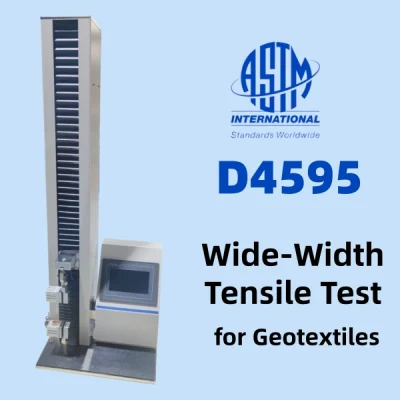
Geotextile Tensile Test: Understanding ASTM D4595
ASTM D4595 defines a standardized approach to measure the tensile properties of geotextiles using a wide-width specimen. Unlike narrow strip tests, this method minimizes edge effects such as “necking,” delivering results that better reflect real-world performance in civil engineering applications.
This geotextile tensile test applies to woven, nonwoven, knitted, and layered geotextiles. Engineers rely on it to determine key parameters such as:
- Tensile strength
- Elongation at break
- Initial and secant modulus
- Breaking toughness
These properties are essential for designing reinforced soil structures, embankments, pavements, and slope stabilization systems.
Wide Width Tensile Strength Test
The wide width tensile strength test differs fundamentally from traditional strip methods. Instead of testing a narrow specimen, ASTM D4595 specifies a wider sample to reduce lateral contraction during loading.
Key advantages include:
- Improved field correlation: Results closely match in-situ geotextile behavior
- Reduced edge stress concentration: Minimizes premature failure near grips
- Better representation of nonwoven materials: Especially important for geotextiles prone to deformation
This makes ASTM D4595 particularly valuable for design-level evaluation, not just quality control.
ASTM D4595 Wide-Width Method Procedure
1. Specimen Preparation
- Use wide-width specimens to minimize necking
- Condition samples under standard laboratory atmosphere
- Wet testing is allowed within 20 minutes after immersion
2. Machine Setup
- Gauge length: 100 ± 3 mm
- Align specimen centrally and vertically
- Apply pre-tension ≤1% of expected breaking force
3. Testing Process
- Start the machine and apply tensile force until rupture
- Record the force–elongation curve
- Discard invalid results (e.g., jaw breaks or slippage)
4. Important Note
Jaw breaks within 5 mm of the grip may be discarded if they significantly deviate from average results. Proper clamping is critical for accuracy.
Geotextiles Tensile Properties Calculation in ASTM D4595
Tensile Strength
- Defined as maximum force per unit width
- Expressed in N/m
Elongation
- Calculated as percentage increase in length
- Measured at break or specified force levels
Tensile Modulus
Includes:
- Initial modulus (early linear region)
- Offset modulus
- Secant modulus (at specific strain levels such as 2%, 5%, 10%)
Breaking Toughness
- Represents energy absorption capacity
- Determined from the area under the force–elongation curve
These parameters provide a comprehensive understanding of geotextile mechanical performance.
CRE Tensile Testing Machine: Core Equipment for ASTM D4595
A CRE tensile testing machine (Constant Rate of Extension) is required to perform ASTM D4595. This equipment applies a controlled elongation rate while continuously measuring force and displacement.
Critical machine requirements:
- Constant strain rate: Typically 10 ± 3 %/min
- Wide gripping system: Full-width clamping to avoid slippage
- Accurate force measurement: Break occurs within 10–90% of full scale
- Data acquisition: Real-time force–elongation curve
Recommended Solution: Cell Instruments Tensile Tester
The Cell Instruments TST-01 Tensile Tester is well-suited for ASTM D4595 applications due to:
- PLC-controlled precision ensuring stable test execution
- Adjustable speed (1–500 mm/min) to meet standard requirements
- High accuracy (±0.5% FS) for reliable tensile data
- Customizable fixtures for wide-width geotextile specimens
- Real-time curve display for modulus and toughness analysis
Its robust construction and flexible configuration make it ideal for laboratories handling diverse geotextile materials.
Ensure accurate geotextile performance evaluation with ASTM D4595 wide-width tensile testing. Using a reliable CRE Tensile Testing Machine like the Cell Instruments TST-01, you can obtain precise tensile strength, elongation, and modulus data for design and quality control. Upgrade your testing capability with advanced instrumentation tailored for geotextile applications and achieve consistent, standards-compliant results.
FAQs
1. What is ASTM D4595 mainly used for?
It measures tensile strength and elongation of geotextiles using a wide-width method for accurate field simulation.
2. Why is wide-width testing preferred over strip testing?
Because it reduces edge effects and provides results closer to actual engineering conditions.
3. What type of machine is required for ASTM D4595?
A CRE tensile testing machine with controlled extension rate and full-width gripping capability.
4. Can wet geotextiles be tested under ASTM D4595?
Yes, the standard includes procedures for both conditioned and wet specimens.
5. What causes jaw breaks and how can they be avoided?
Jaw breaks often result from improper clamping. Adjusting grip surfaces or padding can help prevent them.
 EN
EN  ES
ES  DE
DE  FR
FR  IT
IT  AR
AR  KO
KO  JA
JA  RU
RU  PT
PT  VI
VI  ID
ID  BG
BG  CS
CS  DA
DA  EL
EL  ET
ET  FI
FI  HE
HE  HU
HU  LT
LT  LV
LV  NL
NL  PL
PL  RO
RO  SK
SK  SV
SV  SL
SL  UK
UK  TR
TR  BE
BE  BS
BS  HI
HI  HR
HR  KK
KK  ML
ML  MY
MY  NN
NN  SR
SR  TA
TA  UZ
UZ  SQ
SQ  TH
TH