
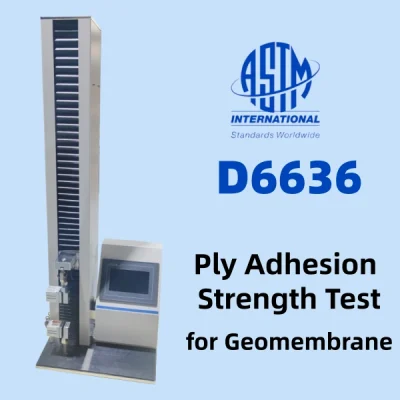
Understanding ASTM D6636 and Its Importance
ASTM D6636 defines a standardized method to evaluate the adhesion strength between plies in reinforced geomembranes using a 180° peel configuration. Engineers and quality control professionals rely on ASTM D6636 to verify bonding integrity in multilayer geomembrane structures such as coated fabrics and internally reinforced liners.
This test method provides a quantitative index value, enabling manufacturers and users to establish minimum acceptable adhesion thresholds. These thresholds ensure that geomembranes perform reliably in demanding applications like landfill liners, mining containment systems, and water reservoirs.
Unlike general tensile tests, ASTM D6636 specifically focuses on interlayer bonding performance, which directly affects durability, leakage resistance, and long-term structural integrity.
Ply Adhesion Strength Test in ASTM D6636
The ply adhesion strength test described in ASTM D6636 measures the force required to separate bonded layers per unit width.
Key Concept
The test evaluates adhesion using the formula:
- SPA = F / W
- SPA: Ply adhesion strength
- F: Measured force
- W: Specimen width
Practical Insight
- The result reflects bond quality, not material strength alone
- Higher values indicate stronger interlayer bonding
- Tearing during testing often suggests adhesion exceeds material tear strength
Why It Matters
Manufacturers and buyers use this test to:
- Define product acceptance criteria
- Monitor process consistency
- Ensure compliance with contractual specifications
Geomembrane Peel Testing Procedure per ASTM D6636
The geomembrane peel testing procedure follows a controlled and repeatable sequence to ensure accuracy.
Specimen Preparation
- Manually separate plies for 25–50 mm
- Ensure clean and uniform peeling initiation
Test Setup
- Clamp both ends securely in a tensile testing machine
- Maintain a 180° peel angle
- Avoid twisting or uneven stress distribution
Test Conditions
- Speed: 50 mm/min (constant rate of extension)
- वातावरण:
- Temperature: 21 ± 2°C
- Humidity: 50–70% RH
Execution
- Record force continuously over at least 100 mm separation length
- Observe failure mode:
- Adhesive separation
- Cohesive failure
- Material tearing
Important Note
If tearing occurs repeatedly, ASTM D6636 states that:
The adhesion strength exceeds the tear strength of the material, and results must be reported accordingly.
Key Factors Affecting ASTM D6636 Results
To obtain reliable ASTM D6636 results, laboratories must control several variables:
1. Specimen Alignment
Improper alignment leads to uneven stress distribution and inaccurate readings.
2. Peel Angle Consistency
Deviation from 180° reduces comparability of results.
3. Test Speed Stability
Fluctuations in speed directly affect measured force values.
4. Environmental Conditions
Temperature and humidity variations influence material behavior.
5. Failure Mode Interpretation
Correctly distinguishing between adhesion failure and tearing is essential for valid reporting.
CRE Tensile Tester for Geomembrane Testing
A CRE tensile tester for geomembrane applications plays a critical role in ensuring test accuracy and repeatability under ASTM D6636.
Why CRE (Constant Rate of Extension)?
- Maintains uniform separation speed
- Ensures consistent force measurement
- Meets ASTM D6636 procedural requirements
Recommended Solution: Cell Instruments TST-01
The TST-01 Tensile Tester from Cell Instruments provides an optimal platform for ASTM D6636 testing:
Key Advantages:
- PLC-controlled system ensures stable and precise operation
- Wide speed range (1–500 mm/min) fully covers ASTM D6636 requirements
- High accuracy (0.5% FS) guarantees reliable force measurement
- Precision ball screw mechanism delivers smooth peel motion
- Multi-fixture compatibility supports peel, tensile, and puncture tests
- Real-time curve display enhances data interpretation
Practical Value
With proper fixtures, the TST-01 allows laboratories to:
- Perform 180° peel tests with high repeatability
- Switch between different test methods efficiently
- Improve testing throughput and consistency
Ensure your geomembrane products meet ASTM D6636 requirements with precise and reliable ply adhesion testing. Using a high-performance CRE tensile tester like the TST-01, you can achieve accurate 180° peel measurements, consistent test speeds, and dependable data output. Improve quality control, validate material performance, and meet industry standards with confidence. Contact Cell Instruments today to optimize your geomembrane testing solutions.
FAQs
1. What does ASTM D6636 measure?
ASTM D6636 measures the force required to separate bonded plies in reinforced geomembranes using a 180° peel test.
2. What is the standard test speed in ASTM D6636?
The standard specifies a constant speed of 50 mm/min, ensuring consistent and comparable results.
3. What happens if the specimen tears during testing?
If tearing occurs repeatedly, the adhesion strength is considered higher than the tear strength, and results must reflect this condition.
4. Why is a CRE tensile tester required?
A CRE tensile tester ensures a constant rate of extension, which is critical for obtaining accurate and standardized results.
5. How is ply adhesion strength calculated?
It is calculated as force divided by specimen width, providing a normalized value for comparison.
 EN
EN  ES
ES  DE
DE  FR
FR  IT
IT  AR
AR  KO
KO  JA
JA  RU
RU  PT
PT  VI
VI  ID
ID  BG
BG  CS
CS  DA
DA  EL
EL  ET
ET  FI
FI  HE
HE  HU
HU  LT
LT  LV
LV  NL
NL  PL
PL  RO
RO  SK
SK  SV
SV  SL
SL  UK
UK  TR
TR  BE
BE  BS
BS  HI
HI  HR
HR  KK
KK  ML
ML  MY
MY  NN
NN  SR
SR  TA
TA  UZ
UZ  SQ
SQ  TH
TH