

Whether developing new corrugated packaging or validating production quality, ISO 2234 testing provides objective data for package optimization and regulatory compliance. Modern compression systems also support multiple testing modes beyond standard compression, enabling laboratories to perform comprehensive packaging performance evaluations using a single instrument.
What Is ISO 2234?
ISO 2234 is an international standard that specifies methods for determining the resistance of filled transport packages to vertical compression loads. The objective is to simulate stacking conditions encountered during warehousing, distribution, and long-term storage.
Unlike material-level compression tests, ISO 2234 evaluates complete packages under realistic loading conditions, providing valuable information about:
- Maximum stacking capacity
- Structural deformation
- Package stability
- Long-term storage performance
- Transportation reliability
The results help manufacturers determine whether packaging designs provide adequate protection without excessive material usage.
Why ISO 2234 Testing Matters
Packaging failures can result in damaged products, increased logistics expenses, customer complaints, and product recalls. Conducting ISO 2234 testing before commercial distribution minimizes these risks.
Major benefits include:
- Verify packaging strength before shipment
- Improve warehouse stacking safety
- Reduce transportation damage
- Optimize corrugated board specifications
- Lower packaging material costs
- Support quality assurance programs
- Demonstrate compliance with international packaging requirements
For companies shipping products worldwide, standardized testing provides consistent quality evaluation regardless of manufacturing location.
How a Box Compression Tester Performs ISO 2234 Testing
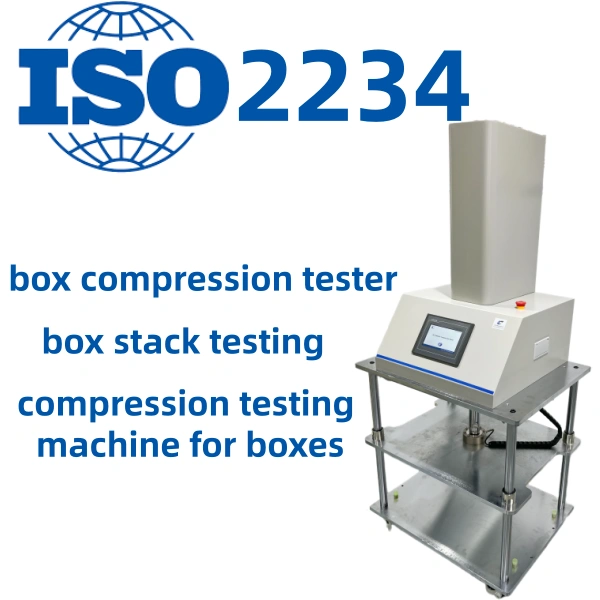
A box compression tester applies a controlled vertical load between two parallel compression platens. During testing, force and displacement are continuously recorded until the specified endpoint or package failure occurs.
The typical testing procedure includes:
| Test Step | Description |
|---|---|
| Sample Preparation | Condition the filled package according to laboratory requirements. |
| Instrument Setup | Select compression speed and test mode. |
| Load Application | Apply vertical compression using controlled platen movement. |
| Data Collection | Record force, displacement, and compression curve. |
| Result Analysis | Determine maximum load, deformation, and package behavior. |
Modern systems automatically generate test curves and printable reports, improving laboratory efficiency while reducing operator error.
Box Compression Testing
This test determines the maximum compressive force a package can withstand before structural failure.
Typical outputs include:
- Maximum compression force
- Failure point
- Compression displacement
- Force-displacement curve
This information supports packaging design optimization and quality control.
Key Features of an ISO 2234 Compression Testing Machine
A modern compression testing machine for boxes combines precision mechanics with intelligent control software to ensure repeatable test results.
Typical features include:
- High-precision load cell
- Servo-controlled compression system
- Heavy-duty four-column frame
- Automatic force and displacement measurement
- Real-time compression curve display
- Touchscreen operation
- Integrated thermal printer
- Programmable test methods
- Safety overload protection
- Optional PC software for report generation
These features improve testing accuracy while simplifying laboratory workflows.
Industries That Benefit from ISO 2234 Testing
Nearly every industry relying on shipping cartons can benefit from ISO 2234 verification.
Typical applications include:
- Corrugated packaging manufacturers
- Food and beverage packaging
- Pharmaceutical packaging
- Medical device packaging
- Consumer goods
- Electronics packaging
- Chemical products
- Cosmetics
- E-commerce logistics
- Third-party testing laboratories
As supply chains become increasingly global, reliable package performance has become a competitive advantage.
Materials Suitable for Compression Testing
A box compression tester can evaluate numerous packaging materials, including:
- Corrugated fiberboard
- Solid fiberboard
- Folding cartons
- Paperboard containers
- Plastic containers
- Plastic crates
- Composite shipping boxes
- Wooden transport cases
- Honeycomb paperboard packaging
Different fixtures and load capacities allow laboratories to accommodate various package dimensions and strength requirements.
Understanding ISO 2234 Test Results
The most valuable outputs from ISO 2234 testing include:
| Parameter | Significance |
|---|---|
| Maximum Compression Force | Indicates ultimate package strength before failure. |
| Compression Displacement | Measures deformation during loading. |
| Compression Curve | Shows package stiffness and structural response. |
| Stack Performance | Predicts warehouse stacking capability. |
| Failure Mode | Identifies weak structural areas for redesign. |
These data enable engineers to improve package performance while reducing unnecessary material consumption.
Related Packaging Standards
Although ISO 2234 is widely recognized for compression testing of complete packages, laboratories often perform additional tests according to related international standards.
Common complementary standards include:
| Standard | Purpose |
|---|---|
| ISO 12048 | Compression and stacking testing of complete packages |
| ASTM D642 | Compression resistance of shipping containers |
| ISO 2872 | Conditioning of complete packages |
| ISO 2874 | Stacking tests for transport packages |
| TAPPI T804 | Compression testing of corrugated containers |
| JIS Z0212 | Compression testing for transport packaging |
| GB/T 4857.4 | Compression testing of transport packages |
Combining these standards provides a comprehensive evaluation of packaging durability across different transportation and storage environments.
Why Choose the BCT-600 Box Compression Tester?
The BCT-600 Box Compression Tester is designed for laboratories requiring accurate ISO 2234 compliance and versatile packaging performance evaluation.
Its integrated servo control system, precision load measurement, touchscreen interface, and multiple testing modes allow users to perform:
- Compression strength testing
- Box stack testing
- Fixed-load testing
- Fixed-deformation testing
The rigid frame construction ensures excellent platen parallelism and repeatability, while optional PC software streamlines report generation and data management. Suitable for research laboratories, quality control departments, packaging manufacturers, and certification organizations, the system delivers reliable results across a wide range of package sizes and load capacities.
Frequently Asked Questions
Is ISO 2234 only applicable to corrugated boxes?
No. ISO 2234 applies to complete transport packages made from corrugated board, plastics, wood, composite materials, and other packaging structures intended for stacking.
What is the difference between ISO 2234 and ASTM D642?
Both standards evaluate compression resistance, but ISO 2234 focuses on filled transport packages under stacking conditions, while ASTM D642 is commonly used for shipping containers and unit loads. Many laboratories perform both standards depending on customer requirements.
Can one instrument perform multiple compression tests?
Yes. Modern compression testing machines for boxes typically support compression strength, box stack testing, fixed-load, and fixed-deformation testing within a single platform.
How does ISO 2234 improve packaging quality?
By identifying structural weaknesses before production, ISO 2234 helps engineers optimize package design, reduce material costs, minimize transportation damage, and improve overall logistics efficiency.
Conclusion
The BCT-600 Box Compression Tester is designed to perform ISO 2234 compression and stacking evaluations for transport packaging. Using precision servo control and high-accuracy load measurement, it measures compressive strength, deformation, and long-term stacking performance of corrugated boxes, cartons, plastic containers, and other shipping packages. Multiple testing modes support comprehensive packaging validation for quality control, product development, and international standards compliance.
Reliable packaging begins with accurate compression testing. Whether you need to verify ISO 2234 compliance, optimize corrugated box designs, or improve warehouse stacking performance, Cell Instruments provides advanced box compression testing solutions tailored to your applications. Contact our technical specialists today to discuss your testing requirements and discover how our customizable systems can support your laboratory, quality assurance, and packaging development projects.
 EN
EN  ES
ES  DE
DE  FR
FR  IT
IT  AR
AR  KO
KO  JA
JA  RU
RU  PT
PT  VI
VI  ID
ID  BG
BG  CS
CS  DA
DA  EL
EL  ET
ET  FI
FI  HE
HE  HU
HU  LT
LT  LV
LV  NL
NL  PL
PL  RO
RO  SK
SK  SV
SV  SL
SL  UK
UK  TR
TR  BE
BE  BS
BS  HI
HI  HR
HR  KK
KK  ML
ML  MY
MY  NN
NN  SR
SR  TA
TA  UZ
UZ  SQ
SQ  TH
TH