
Overview of Bottle Cap Torque Testing
Bottle cap torque testing is a critical quality control process used to evaluate the application and removal torque of bottle closures. Proper torque ensures container sealing integrity, consumer usability, and compliance with international packaging standards.
In industries such as food, beverages, pharmaceuticals, medical devices, and daily chemicals, torque control directly affects product safety, shelf life, and brand reputation. A standardized bottle cap torque testing solution helps manufacturers maintain consistency across production, inspection, and validation stages.
Why Standardized Bottle Cap Torque Testing Is Essential
Bottle cap torque values cannot rely on subjective judgment. Variations in capping machines, closure materials, liners, and bottle threads introduce measurable risk.
Standardized bottle cap torque testing helps to:
- Control sealing performance and reduce leakage risk
- Ensure consistent opening force for end users
- Support regulatory audits and quality documentation
- Improve repeatability across operators and laboratories
International standards define how torque should be measured, ensuring data reliability and comparability.
Bottle Cap Torque Testing Method and Applicable Standard
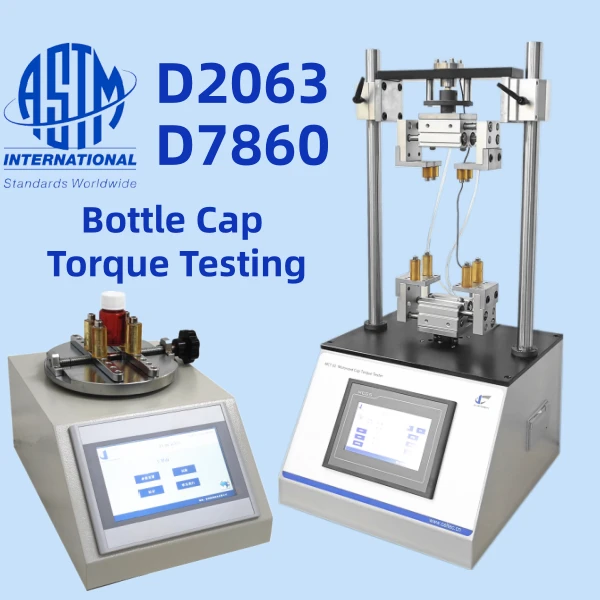
Bottle cap torque testing is primarily divided into manual testing methods and automatic testing methods, each governed by specific ASTM standards.
Manual Bottle Cap Torque Testing
Standard: ASTM D2063
ASTM D2063 describes a manual closure torque testing method used to measure the rotational force required to apply or remove a bottle cap.
Key characteristics of ASTM D2063 testing include:
- Operator-applied rotational force
- Measurement of peak application or removal torque
- Flexible use across different bottle and closure sizes
- Suitability for routine quality inspection
This method is widely adopted for incoming inspection, on-site quality control, and production spot checks, where flexibility and efficiency are required.
Automatic Bottle Cap Torque Testing
Standard: ASTM D7860
ASTM D7860 defines an automatic bottle cap torque testing method using motorized rotation to control test speed and direction.
Key characteristics of ASTM D7860 testing include:
- Controlled rotational speed and direction
- Automated peak torque detection
- Reduced operator influence
- Higher repeatability and reproducibility
This method is commonly used in R&D validation, process capability studies, and third-party laboratory testing, where data consistency is critical.
Standards and Related Torque Testing Instrument
A reliable bottle cap torque testing solution requires instruments that properly support the selected test method and standard.
Manual Torque Tester for Bottles
Recommended for ASTM D2063
To correctly perform manual bottle cap torque testing according to ASTM D2063, the instrument must provide stable bottle fixation, accurate torque sensing, and clear peak value capture.
Cell Instruments TT-01 is designed to support manual closure torque testing by offering:
- High-accuracy digital torque measurement
- Stable and adjustable bottle fixtures
- Clear peak torque display for application and removal tests
- Suitability for a wide range of bottle and cap sizes
The TT-01 is ideal for quality control laboratories and production environments where ASTM D2063 compliance is required.
Automatic Torque Tester for Bottles
Recommended for ASTM D7860
Automatic bottle cap torque testing under ASTM D7860 requires precise control of rotational motion and consistent test conditions.
Cell Instruments MCT-01 supports automatic torque testing by providing:
- Motor-driven, controlled rotation speed
- Automatic peak torque capture
- Reduced operator variability
- Reliable data output for validation and reporting
The MCT-01 is well suited for R&D laboratories, packaging development centers, and quality verification applications following ASTM D7860.
Bottle Cap Torque Testing Solution from Cell Instruments
By combining standard-compliant testing methods with application-oriented instrumentation, Cell Instruments provides a structured bottle cap torque testing solution that delivers:
- Clear alignment between test standards and equipment
- Reliable and repeatable torque data
- Flexible adaptation to different bottle and closure types
- Support for regulated and non-regulated industries
With expertise in packaging materials testing, automation, and customization, Cell Instruments helps customers build torque testing systems that match real production and laboratory needs.
 NN
NN  EN
EN  ES
ES  DE
DE  FR
FR  IT
IT  AR
AR  KO
KO  JA
JA  RU
RU  PT
PT  VI
VI  ID
ID  BG
BG  CS
CS  DA
DA  EL
EL  ET
ET  FI
FI  HE
HE  HU
HU  LT
LT  LV
LV  NL
NL  PL
PL  RO
RO  SK
SK  SV
SV  SL
SL  UK
UK  TR
TR  BE
BE  BS
BS  HI
HI  HR
HR  KK
KK  ML
ML  MY
MY  SR
SR  TA
TA  UZ
UZ  SQ
SQ