
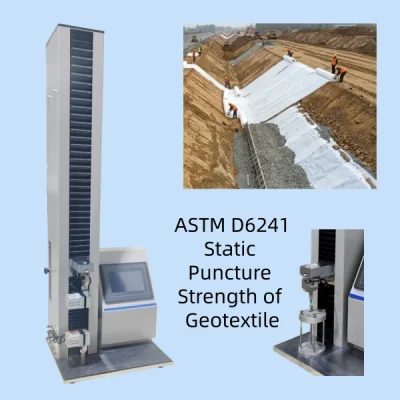
Geotextiles play a critical role in civil engineering and environmental protection systems. They provide filtration, separation, reinforcement, and protection in applications such as road construction, drainage systems, landfills, and erosion control. Because these materials often experience localized stresses from sharp stones or construction loads, engineers must evaluate their resistance to penetration damage.
ASTM D6241 defines a standardized method for determining the static puncture strength of geotextile materials using a cylindrical probe. The test provides an index value that reflects the ability of geotextiles and related geosynthetic products to resist puncture forces during installation and service.
By applying a controlled load to the specimen, the geotextile puncture resistance test helps manufacturers, quality inspectors, and engineers ensure that geotextile materials meet required mechanical performance criteria.
ASTM D6241 Static Puncture Strength of Geotextile and Geotextile Puncture Resistance Test
The static puncture strength of geotextile measures the maximum force required to push a probe through a clamped specimen. ASTM D6241 specifies the use of a 50 mm diameter cylindrical probe, which presses against the unsupported center of the specimen until rupture occurs.
This geotextile puncture resistance test provides a reliable index value for comparing different geotextile products. Manufacturers and laboratories frequently use the results to evaluate durability during installation, where sharp aggregates or construction loads may cause puncture damage.
Key characteristics of the method include:
- A circular clamping fixture that secures the specimen without initial tension
- A 50 mm cylindrical probe that applies the puncture load
- A constant crosshead speed controlled by the testing machine
- Measurement of maximum puncture force at the moment of rupture
Although the test does not replicate all field conditions, it offers a consistent and repeatable laboratory method to evaluate puncture resistance performance.
Principle of the ASTM D6241 Test Method
The ASTM D6241 procedure uses a universal testing machine equipped with a puncture probe and clamping fixture.
During the test:
- The geotextile specimen is placed between circular clamps.
- The clamps secure the material without introducing tension.
- A cylindrical probe moves vertically toward the center of the specimen.
- The probe continues to penetrate the material until rupture occurs.
- The system records the maximum puncture force, which represents the static puncture strength.
The result is typically expressed in Newtons (N) and reported as the average value of multiple specimens. Engineers use this value as a comparative indicator of puncture resistance.
Why Static Puncture Strength Matters in Geotextile Applications
In many geotechnical structures, geotextiles lie directly against coarse soil, gravel, or construction debris. These materials create concentrated stresses that can puncture weak fabrics.
The ASTM D6241 geotextile puncture resistance test helps evaluate whether a material can withstand such conditions. High puncture resistance often correlates with improved durability during installation and long-term performance.
Typical performance considerations include:
- Protection of geomembranes in landfill liners
- Resistance to aggregate penetration in road construction
- Durability during soil compaction processes
- Long-term structural stability of geosynthetic systems
By comparing test results, engineers can select geotextiles that offer adequate protection and mechanical strength.
ASTM D6241 Testing Equipment and Laboratory Setup
A reliable tensile or compression testing machine forms the core of the ASTM D6241 setup. The system must deliver precise force control and stable loading conditions.
Laboratories typically require:
- A universal testing machine with appropriate load capacity
- A 50 mm diameter cylindrical puncture probe
- A ring clamp fixture to secure the specimen
- Accurate force and displacement measurement systems
For laboratories performing multiple material tests, a versatile system improves efficiency. The Cell Instruments TST-01 Tensile Tester provides a practical solution for puncture testing and other mechanical evaluations.
Key advantages of the TST-01 include:
- PLC-controlled operation with a 7-inch touchscreen interface for intuitive testing
- Precision ball screw drive system ensuring stable and repeatable loading
- Adjustable test speeds (1–500 mm/min) suitable for different standards
- Multi-fixture compatibility, enabling tensile, peel, tear, and puncture tests on the same platform
- High measurement accuracy (0.5% full scale) for reliable laboratory data
With its robust structure and flexible configuration, the TST-01 allows laboratories to perform ASTM D6241 tests while also supporting a wide range of geosynthetic and packaging material evaluations.
Key Considerations for Accurate ASTM D6241 Results
To ensure reliable test data, laboratories should carefully control several factors:
Specimen preparation
Cut specimens with consistent dimensions and avoid edge damage.
Clamp alignment
Ensure the specimen remains centered within the ring clamps to prevent uneven stress distribution.
Machine speed consistency
Follow the speed specified by the test method to maintain comparability.
Multiple test samples
Conduct several repetitions and report the average puncture force.
Proper laboratory procedures significantly improve the repeatability and reliability of the static puncture strength of geotextile measurements.
ASTM D6241 provides a standardized method for evaluating the static puncture strength of geotextile materials. The test measures the maximum force required to penetrate a geotextile specimen with a cylindrical probe, offering a consistent index for comparing puncture resistance.
Engineers rely on this geotextile puncture resistance test to assess material durability in demanding construction environments. By combining standardized procedures with reliable testing equipment such as the Cell Instruments TST-01, laboratories can generate accurate data that supports material selection, quality control, and long-term geosynthetic performance.
 EN
EN  ES
ES  DE
DE  FR
FR  IT
IT  AR
AR  KO
KO  JA
JA  RU
RU  PT
PT  VI
VI  ID
ID  BG
BG  CS
CS  DA
DA  EL
EL  ET
ET  FI
FI  HE
HE  HU
HU  LT
LT  LV
LV  NL
NL  PL
PL  RO
RO  SK
SK  SV
SV  SL
SL  UK
UK  TR
TR  BE
BE  BS
BS  HI
HI  HR
HR  KK
KK  ML
ML  MY
MY  NN
NN  SR
SR  TA
TA  UZ
UZ  SQ
SQ  TH
TH