
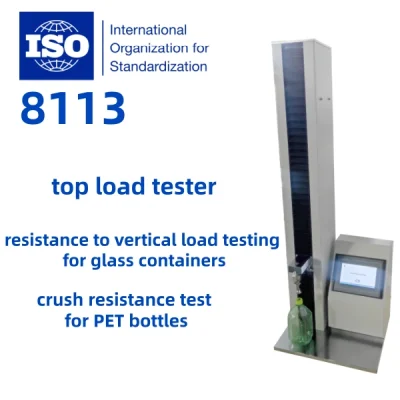
ISO 8113 Overview
Packaging containers must withstand various mechanical stresses during filling, transportation, stacking, storage, and handling. ISO 8113 specifies a test method for evaluating the resistance to vertical load testing for glass containers, helping manufacturers verify whether containers can maintain structural integrity under applied compression forces. A professional top load tester provides accurate and repeatable measurements of container strength, allowing engineers to identify weak designs, optimize material usage, and improve packaging reliability.
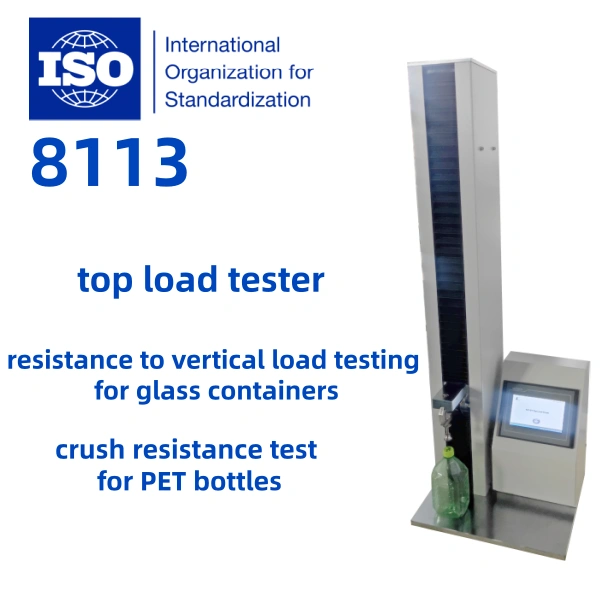
The TLT-01 Top Load Tester from Cell Instruments is designed for automated top load testing of bottles, containers, drums, cartons, trays, and other packaging structures. By applying controlled vertical compression and measuring the relationship between load and deformation, the system helps laboratories evaluate the crush resistance test for PET bottles, glass containers, and other rigid packaging products. The instrument supports quality control programs based on international standards, including ISO 8113, ASTM D642, ASTM D4577, ASTM D2659, and ASTM D4169.
What Is ISO 8113 Vertical Load Resistance Testing?
ISO 8113 is an international testing standard related to the evaluation of glass container resistance against vertical compression forces. The test determines how much vertical load a glass container can withstand before reaching a specified deformation level or structural failure.
Glass containers such as beverage bottles, pharmaceutical bottles, and food packaging jars experience vertical forces throughout their lifecycle. These forces may occur during:
- Bottle stacking in warehouses
- Transportation vibration and compression
- Filling and capping operations
- Packaging line handling
- Storage under load conditions
The purpose of ISO 8113 testing is to ensure that containers have sufficient mechanical strength to avoid cracking, collapsing, or permanent deformation during normal use.
For packaging manufacturers, this test provides valuable engineering data to evaluate:
- Container design performance
- Glass thickness distribution
- Structural safety margins
- Production consistency
- Material optimization opportunities
A reliable top load testing system allows manufacturers to simulate real-world compression conditions and make data-driven improvements before products reach the market.
Why Is Vertical Load Testing Important for Packaging Quality?
Packaging failures can result in product leakage, contamination, recalls, transportation losses, and customer complaints. For industries using rigid containers, compression strength is a critical quality parameter.
The resistance to vertical load testing for glass containers provides several important benefits:
| Benefit | Description |
|---|---|
| Prevents container failure | Identifies weak points that may cause cracks, deformation, or collapse |
| Improves packaging safety | Confirms containers can withstand expected handling and stacking forces |
| Supports product development | Helps engineers optimize shape, thickness, and material distribution |
| Reduces production risks | Detects manufacturing variations and quality problems |
| Improves transportation reliability | Ensures containers maintain performance throughout logistics processes |
For example, a beverage company developing a lightweight glass bottle may reduce glass usage to lower manufacturing costs. However, reducing wall thickness can affect compression resistance. ISO 8113 testing helps engineers determine whether the redesigned bottle still provides sufficient vertical load strength.
How Does a Top Load Tester Work?
A top load tester evaluates container strength by applying a controlled vertical compression force through two parallel compression plates. The sample is positioned between the plates, and the upper platen moves downward at a controlled speed until the programmed test condition is achieved.
During the test, the system continuously records:
- Applied compression force
- Compression displacement
- Maximum load value
- Deformation behavior
- Failure point (when applicable)
The basic testing principle includes three steps:
- Sample positioning
The container is placed vertically between the compression platens. Proper alignment ensures that the applied load represents real stacking conditions. - Vertical compression application
The tester applies an increasing load through the upper platen according to the selected test program. - Data measurement and analysis
The system records load and deformation values, allowing engineers to evaluate structural performance.
The TLT-01 uses a precision ball-lead screw mechanism combined with PLC control and a 7-inch HMI touchscreen interface. This design provides stable movement, accurate force measurement, and repeatable testing results for laboratory and production quality control applications.
Top Load Testing Methods and Evaluation Parameters
Different packaging applications require different testing approaches. Modern compression testing equipment supports multiple test modes to meet various quality control requirements.
The TLT-01 Top Load Tester provides several programmable testing methods:
| Test Mode | Application Purpose |
|---|---|
| Peak Load Test | Determines the maximum compression force before failure |
| Fixed Deformation Test | Measures load performance at a defined deformation level |
| Fixed Load Test | Evaluates deformation behavior under constant force |
| Single Test | Performs individual container strength evaluation |
| Cyclic Test | Simulates repeated compression conditions |
These methods allow engineers to analyze different aspects of packaging performance.
For glass containers tested according to ISO 8113, the primary concern is usually the maximum vertical force the container can resist before failure. For plastic bottles, especially PET containers, engineers may focus on deformation characteristics and long-term compression performance.
Testing Procedure for Glass Containers and PET Bottles
A typical top load testing procedure includes the following steps:
Sample Preparation
Samples should represent normal production conditions. Engineers typically select containers from different production batches to evaluate consistency.
Important preparation factors include:
- Clean and dry containers
- Correct container orientation
- Representative sample quantity
- Proper removal of external damage or defects
Equipment Setup
Before testing:
- Select the appropriate compression platen
- Set test speed and load parameters
- Calibrate force measurement if required
- Configure the test program
For glass container testing under ISO 8113, correct alignment is essential because uneven loading may affect results.
Compression Testing
During testing:
- The upper platen moves downward
- Compression force increases gradually
- The system measures force and displacement
- The maximum load value is recorded
The test continues until the required endpoint is reached, such as:
- Container failure
- Maximum load achievement
- Defined deformation condition
Result Evaluation
Test results can help determine:
- Maximum vertical load capacity
- Compression resistance characteristics
- Deformation behavior
- Production consistency
Engineers can use this information to compare different container designs or verify whether products meet internal and international requirements.
Applications of ISO 8113 Top Load Testing in Packaging Industries
The requirements for container strength vary significantly among industries. Glass containers, plastic bottles, and rigid packaging systems must maintain mechanical integrity throughout manufacturing, distribution, and end-user handling. A top load tester provides manufacturers with quantitative data to evaluate packaging performance and improve product reliability.
Glass Container Testing Applications
Glass packaging is widely used in beverage, food, pharmaceutical, and cosmetic industries because of its excellent barrier properties and chemical stability. However, glass containers are vulnerable to mechanical stress if their design does not provide sufficient strength.
The resistance to vertical load testing for glass containers helps manufacturers evaluate:
- Bottle neck strength
- Shoulder structure performance
- Base load-bearing capability
- Overall container durability
Typical applications include:
- Beverage bottles for carbonated drinks, juice, and water
- Pharmaceutical glass bottles
- Food jars and specialty containers
- Cosmetic glass packaging
By applying controlled vertical compression, manufacturers can verify whether containers can withstand stacking pressure during warehouse storage and transportation.
PET Bottle Crush Resistance Testing
Although ISO 8113 focuses on glass containers, similar vertical compression evaluation methods are widely applied to PET bottles and plastic containers.
The crush resistance test for PET bottles helps engineers understand how plastic containers behave under external loads. PET bottles may deform due to:
- Stacking pressure
- Temperature changes
- Vacuum conditions after filling
- Transportation vibration
Top load testing allows packaging designers to optimize:
- Bottle shape
- Rib structures
- Material thickness
- Weight reduction strategies
For example, a beverage manufacturer may redesign a PET bottle using less resin to reduce production costs. Compression testing verifies whether the lightweight design still provides sufficient mechanical stability.
Top Load Tester for Packaging Quality Control
A professional top load tester is an essential instrument for laboratories and quality control departments that need reliable compression performance data.
The TLT-01 Top Load Tester combines mechanical precision with intelligent control technology to support efficient testing workflows.
Technical Features of TLT-01 Top Load Tester
| Parameter | Specification |
|---|---|
| Test Range | 0–1000 N (customizable according to requirements) |
| Sample Height | Up to 700 mm |
| Maximum Sample Diameter | 120 mm |
| Test Speed | 1–500 mm/min |
| Displacement Accuracy | 0.01 mm |
| Force Accuracy | ±0.5% Full Scale |
| Control System | PLC and 7-inch HMI touchscreen |
| Data Output | Screen display, optional microprinter, optional RS232 |
| Power Supply | 110–220 V, 50/60 Hz |
These specifications allow the instrument to handle various packaging compression applications, from small pharmaceutical containers to larger industrial packaging products.
Advantages of Automated Top Load Testing Equipment
Compared with manual compression evaluation methods, automated testing equipment provides improved accuracy, efficiency, and repeatability.
High Testing Accuracy
The precision ball-lead screw mechanism ensures smooth platen movement and stable loading conditions. Accurate force and displacement measurement helps laboratories obtain reliable test data.
Flexible Test Programming
Different packaging products require different evaluation methods. The TLT-01 supports multiple testing modes, allowing engineers to create customized test procedures according to product requirements.
Improved Testing Efficiency
PLC control and touchscreen operation simplify the testing process. Operators can quickly configure parameters, perform tests, and review results without complicated procedures.
Better Quality Control Decisions
Compression data helps companies:
- Identify production problems
- Compare packaging designs
- Verify supplier quality
- Optimize material usage
- Improve product protection
Relationship Between ISO 8113 and Other Compression Testing Standards
Packaging manufacturers often use multiple standards because different container types and transportation conditions require different evaluation methods.
| Standard | Application | Testing Focus |
|---|---|---|
| ISO 8113 | Glass containers | Resistance to vertical load |
| ASTM D642 | Shipping containers and unit loads | Compression resistance |
| ASTM D4577 | Containers under constant load | Long-term compression performance |
| ASTM D2659 | Blown thermoplastic containers | Column crush properties |
| ASTM D4169 | Shipping systems | Distribution performance testing |
While these standards share the common goal of evaluating packaging strength, they address different product categories and testing conditions.
For example:
- ISO 8113 is suitable for evaluating the vertical load resistance of glass containers.
- ASTM D2659 focuses on the column crush performance of blown plastic containers.
- ASTM D642 evaluates the compression strength of shipping containers and packaging systems.
Selecting the correct testing standard ensures that the test results accurately represent the intended application.
Real-World Example: Improving Bottle Design Through Compression Testing
A glass bottle manufacturer noticed that some bottles experienced cracking during warehouse stacking. Engineers suspected that changes in bottle geometry and glass distribution affected vertical strength.
The company performed top load testing using controlled compression conditions. The results showed differences in load resistance between several bottle designs.
Based on the test data, engineers optimized:
- Bottle shoulder curvature
- Glass thickness distribution
- Manufacturing parameters
After redesign, the improved bottle achieved higher compression resistance while maintaining the desired appearance and weight.
This example demonstrates how top load testing supports product development beyond simple quality inspection. It provides engineering information that helps manufacturers create safer, lighter, and more cost-effective packaging.
How to Select the Right Top Load Tester?
When choosing compression testing equipment, laboratories should consider several factors:
Testing Application
Different products require different testing capabilities:
- Glass bottles → ISO 8113 vertical load testing
- PET bottles → crush resistance evaluation
- Cartons and shipping containers → ASTM D642 compression testing
- Industrial containers → customized compression testing
Load Capacity Requirements
The tester should provide sufficient force capacity for the application. A 1000 N system is suitable for many packaging applications, while special applications may require customized load ranges.
Sample Size Compatibility
The compression area and vertical travel should match the container dimensions. Large bottles, drums, or cartons require appropriate fixture designs.
Data Management Requirements
Modern laboratories may require:
- Digital data recording
- Computer communication
- Test reports
- Quality management integration
Customized software and fixtures can help meet specialized testing requirements.
Why Choose Cell Instruments for Top Load Testing Solutions?
Cell Instruments specializes in material and packaging testing solutions, providing professional testing equipment for global laboratories, manufacturers, and quality control organizations.
The company provides:
- Standard top load testing instruments
- Customized testing fixtures
- Multi-station testing systems
- Application-specific testing solutions
With expertise in packaging materials, medical packaging, pharmaceutical packaging, and flexible packaging testing, Cell Instruments helps customers develop reliable testing methods that match their production and quality requirements.
The TLT-01 Top Load Tester provides accurate compression evaluation for glass containers, PET bottles, cartons, and other packaging products. By combining precise mechanical design, intelligent control, and compatibility with international standards, it supports manufacturers in improving packaging safety, reducing material waste, and maintaining consistent product quality.
Key Points
Reliable compression performance is essential for ensuring packaging safety, reducing product damage, and improving manufacturing efficiency. Through professional top load testing, engineers can accurately evaluate container strength, optimize designs, and maintain consistent quality across production batches. Cell Instruments provides advanced top load testing solutions, including the TLT-01 Top Load Tester, customized fixtures, and application-specific testing systems for glass containers, PET bottles, and various packaging products. Contact our technical team to explore the right testing solution for your packaging evaluation requirements.
 EN
EN  ES
ES  DE
DE  FR
FR  IT
IT  AR
AR  KO
KO  JA
JA  RU
RU  PT
PT  VI
VI  ID
ID  BG
BG  CS
CS  DA
DA  EL
EL  ET
ET  FI
FI  HE
HE  HU
HU  LT
LT  LV
LV  NL
NL  PL
PL  RO
RO  SK
SK  SV
SV  SL
SL  UK
UK  TR
TR  BE
BE  BS
BS  HI
HI  HR
HR  KK
KK  ML
ML  MY
MY  NN
NN  SR
SR  TA
TA  UZ
UZ  SQ
SQ  TH
TH