

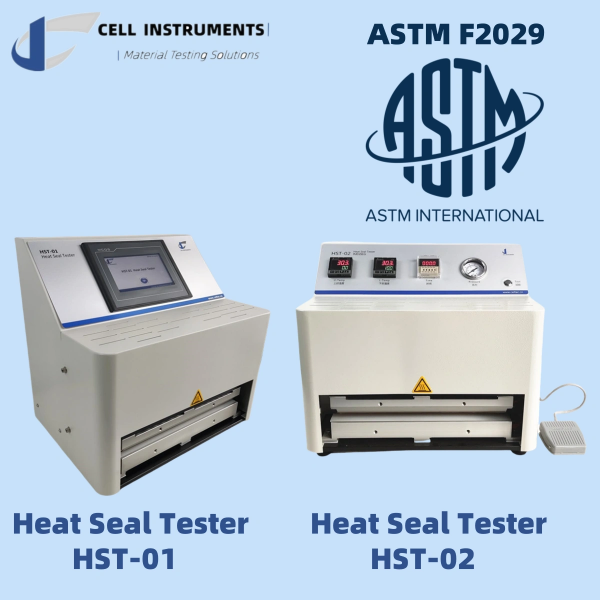
ASTM F2029
ASTM F2029 Heat Seal Strength Testing
Understanding the ASTM F2029 standard is critical for manufacturers and quality control professionals working with flexible barrier materials. The standard outlines recommended laboratory heat sealing procedures to evaluate the heat sealing performance of plastic films by measuring seal strength. As demand for reliable packaging grows in industries such as pharmaceuticals, food, and electronics, instruments such as laboratory heat sealers are able to effectively perform testing in accordance with the ASTM F2029 standard, optimize sealing parameters, and improve product quality.
Heat Seal Strength Test Method and Its Importance
The heat seal strength test method defined in ASTM F2029 allows you to analyze how changes in material or processing conditions impact seal performance. The method involves forming heat seals under controlled lab conditions and measuring the strength of the resulting bonds.
Key sealing variables:
- Sealing temperature (both jaws typically set equally)
- Dwell time
- Sealing pressure
- Jaw material and surface covering
These parameters affect the performance of heat-sealable layers in multilayer films. For instance, PET/LDPE laminates and other multilayer barrier materials exhibit varying seal behaviors depending on seal layer composition, thickness, and orientation.
Understanding the Heat Sealability of Plastic Films
Heat sealability of plastic films refers to the material’s ability to form consistent and strong seals under specific thermal and mechanical conditions. ASTM F2029 helps determine the optimal sealing window by generating heat seal curves, typically using a stepwise temperature profile.
A reliable heat seal must:
- Withstand intended application stress
- Maintain barrier integrity
- Avoid distortion, shrinkage, or burn-through at high temperatures
Material compatibility, such as sealing film-to-film or film-to-foil, also influences sealability outcomes. Therefore, identifying the seal initiation temperature, maximum seal strength temperature, and failure modes (e.g., cohesive, adhesive, or delamination) is crucial.
Laboratory Heat Sealer Setup for ASTM F2029 Testing
To comply with ASTM F2029, a laboratory heat sealer must offer accurate and repeatable control over time, temperature, and pressure. The Cell Instruments heat seal tester is engineered for such applications, delivering stable sealing conditions and adjustable configurations for various materials and formats.
Key Setup Considerations:
- Use flat steel jaws with TFE-fluorocarbon/glass cloth coverings
- Set pressure between 276–483 kPa (40–70 psi) or as appropriate
- Maintain consistent jaw alignment and calibration
- Avoid material sticking using interleaving film or covered jaws when needed
- Always note seal orientation (machine or transverse direction)
Cut test specimens to standard strip widths of 15 mm or 25 mm. Use replicate samples to assess statistical reliability across temperature points.
Performing the ASTM F2029 Heat Seal Strength Test
Once the equipment is set up:
- Condition test samples if needed per ASTM D4332.
- Seal specimens at incrementally increasing temperatures (e.g., in 5–10°C steps).
- Measure seal strength using tensile test methods, typically ASTM F88.
- Record:
- Force to failure (N or lb)
- Type of failure (adhesive, cohesive, delamination)
- Sealing temperature, time, and pressure
- Plot heat seal curves to identify the optimal sealing window.
This data supports material development, production quality assurance, and comparative analysis of alternative packaging substrates.
Reporting and Interpretation of Results
A comprehensive ASTM F2029 test report should include:
- Sealing conditions: temperature, time, pressure
- Sample orientation and construction details
- Seal strength values and failure modes
- Average and standard deviation per test set
- Heat seal curves showing temperature vs. seal strength
Interpreting these results helps packaging engineers define manufacturing process parameters and evaluate material changes.
Choose Cell Instruments for ASTM F2029 Testing
Cell Instruments’ laboratory heat sealer is purpose-built for ASTM F2029 and other related standards. It ensures:
- Precise thermal control
- Programmable dwell times
- Customizable pressure settings
- High consistency across multiple seals
Whether you’re conducting R&D, qualifying new suppliers, or performing routine QA, our heat seal tester provides the accuracy, repeatability, and flexibility needed for rigorous testing of heat-sealable films.

Contact Us Get ASTM F2029 Testing Solution
Understanding and applying ASTM D2029 heat seal testers ensures that plastic films are reliable, safe, and heat sealable in real-world applications. With well-established testing procedures and techniques, professionals can confidently evaluate the heat sealability of films to drive product improvements and maintain high quality standards.
To learn more about Cell Instruments heat seal testers or to discuss custom testing needs, contact our technical team today!
 EN
EN  ES
ES  DE
DE  FR
FR  IT
IT  AR
AR  KO
KO  JA
JA  RU
RU  PT
PT  VI
VI  ID
ID  BG
BG  CS
CS  DA
DA  EL
EL  ET
ET  FI
FI  HE
HE  HU
HU  LT
LT  LV
LV  NL
NL  PL
PL  RO
RO  SK
SK  SV
SV  SL
SL  UK
UK  TR
TR