
Why Bottle Thickness Measurement Matters in Packaging
Manufacturers must balance lightweighting strategies with mechanical strength requirements. If wall thickness is too low, bottles may crack, leak, or fail during transportation. If it is too high, material costs increase and sustainability targets suffer.
Bottle thickness measurement helps manufacturers:
- Control raw material consumption
- Maintain burst and compression strength
- Ensure sealing performance
- Meet regulatory and customer specifications
- Improve process stability during blow molding or forming
In industries such as food, beverage, pharmaceutical, and daily chemicals, quality teams rely on thickness data to validate production consistency and reduce defect rates.
Plastic Bottle Thickness and Glass Bottle Thickness
Different materials require different measurement considerations. Understanding these differences improves accuracy and repeatability.
Plastic Bottle Thickness
Plastic bottle thickness is typically measured for PET, HDPE, PP, or multilayer containers. During extrusion blow molding or injection stretch blow molding, uneven material distribution often occurs at the shoulder, base, and grip areas.
Key challenges include:
- Non-uniform wall distribution
- Complex bottle geometries
- Patterned or embossed surfaces
- Thin-wall lightweight designs
Quality control teams usually check:
- Sidewall thickness
- Bottom thickness
- Corner and shoulder transition areas
Accurate bottle thickness measurement allows engineers to adjust mold design, air pressure, and stretch ratios to optimize material distribution.
Glass Bottle Thickness
Glass bottle thickness focuses more on structural safety and thermal resistance. Because glass behaves as a brittle material, small thickness deviations can significantly impact mechanical strength.
For glass containers, testing commonly targets:
- Heel and base thickness
- Body wall thickness
- Neck finish region
Precise measurement helps prevent breakage during filling, capping, and pasteurization processes. Consistent bottle thickness measurement also supports compliance with safety standards in pharmaceutical and food applications.
Common Methods for Bottle Thickness Measurement
Selecting the correct method depends on bottle material, geometry, and production environment.
Mechanical Contact Measurement
This method uses a probe-and-anvil system to directly measure wall thickness. Operators place the bottle between measuring points and record digital readings.
Advantages:
- High accuracy
- Suitable for complex shapes
- Reliable for both plastic and glass
Mechanical methods work especially well for laboratory inspection and incoming quality control.
Ultrasonic Measurement
Ultrasonic systems measure thickness without cutting the sample. They work by transmitting sound waves through the material and calculating thickness from signal return time.
Advantages:
- Non-destructive
- Fast measurement
- Suitable for production lines
However, surface conditions and material transparency can influence accuracy.
Sectioning and Microscopic Analysis
In R&D environments, engineers may cut samples and measure cross-sections under microscopes. This provides detailed distribution data but destroys the sample and requires additional preparation time.
Key Measurement Positions and Control Points
To achieve meaningful bottle thickness measurement results, quality personnel should standardize measurement locations. Typical checkpoints include:
- Base center
- Heel transition
- Mid-body wall
- Shoulder area
- Neck finish
Establishing fixed testing positions ensures data consistency and supports statistical process control (SPC).
Important: Always calibrate measuring instruments before testing and verify repeatability using reference standards.
How Accurate Bottle Thickness Measurement Improves Production
Precise thickness control creates measurable operational benefits:
- Reduced material waste
- Improved compression and top-load performance
- Lower rejection rates
- Enhanced brand reliability
- Better compliance with packaging standards
For manufacturers targeting lightweight packaging, thickness optimization becomes a competitive advantage. Reliable bottle thickness measurement supports data-driven decisions rather than trial-and-error adjustments.
Recommended Instrument: Cell Instruments WTT Wall Thickness Tester
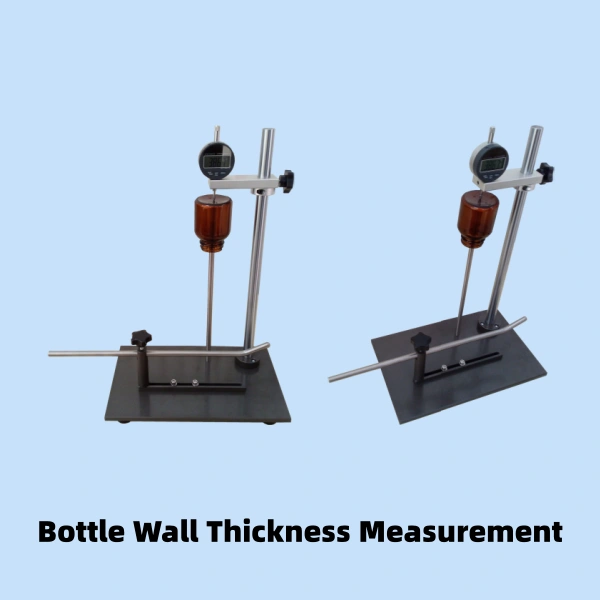
For laboratory and quality inspection applications, the WTT Wall Thickness Tester from Cell Instruments provides a practical solution for bottle thickness measurement.
The system supports:
- Digital measurement display for precise readings
- Measurement of both wall and bottom thickness
- Adaptability to complex container shapes
- Optional data export to Excel for analysis and reporting
Unlike general-purpose gauges, the WTT series is engineered specifically for packaging containers with patterned or irregular structures. Quality engineers can quickly measure plastic bottle thickness or glass bottle thickness without complicated setup procedures.
By integrating thickness testing into routine QC workflows, manufacturers gain full visibility into material distribution and long-term process stability.
Best Practices for Reliable Results
To maximize measurement reliability:
- Use standardized sampling plans
- Measure multiple positions per bottle
- Record environmental conditions
- Train operators to minimize handling errors
- Analyze trends instead of single data points
Consistent bottle thickness measurement transforms raw data into actionable production insights.
Conclusion
Bottle thickness measurement is more than a routine inspection step. It is a strategic quality control process that directly influences packaging safety, cost efficiency, and product performance.
Whether evaluating plastic bottle thickness in lightweight beverage containers or monitoring glass bottle thickness for pharmaceutical applications, precise measurement enables manufacturers to maintain high standards while optimizing material use.
By adopting professional testing equipment such as the Cell Instruments WTT and implementing systematic measurement procedures, companies can strengthen quality assurance systems and enhance their competitiveness in demanding packaging markets.
 NN
NN  EN
EN  ES
ES  DE
DE  FR
FR  IT
IT  AR
AR  KO
KO  JA
JA  RU
RU  PT
PT  VI
VI  ID
ID  BG
BG  CS
CS  DA
DA  EL
EL  ET
ET  FI
FI  HE
HE  HU
HU  LT
LT  LV
LV  NL
NL  PL
PL  RO
RO  SK
SK  SV
SV  SL
SL  UK
UK  TR
TR  BE
BE  BS
BS  HI
HI  HR
HR  KK
KK  ML
ML  MY
MY  SR
SR  TA
TA  UZ
UZ  SQ
SQ  TH
TH