
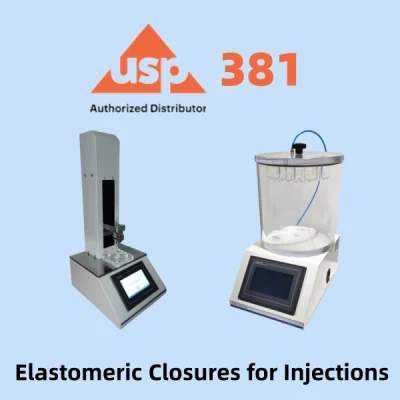
USP 381 & Elastomeric Closure Testing
USP 381 defines the functional and physicochemical requirements for elastomeric closures used in injectable drug packaging. These closures must maintain sterility, prevent contamination, and ensure repeated usability when required. In USP 381 testing, functionality tests focus on how closures behave during actual use, especially under repeated needle puncture conditions.
Elastomeric closure testing directly impacts drug safety and packaging integrity. Laboratories and manufacturers rely on standardized methods to evaluate closure performance, ensuring compliance with pharmacopeial expectations and regulatory frameworks.
USP 381 Elastomeric Closures for Injections
The usp 381 elastomeric closures for injections standard emphasizes three critical functionality tests:
- Penetrability
- Fragmentation
- Self-sealing capacity
These tests simulate real-world clinical use, particularly for closures designed for hypodermic needle access. Proper sample preparation remains essential: closures must undergo Solution S treatment and air drying before testing.
Key principle: testing replicates repeated puncture conditions while maintaining strict measurement accuracy and reproducibility.
Penetrability Test in USP 381 Testing
The penetrability test evaluates the force required for a needle to pierce the closure.
Procedure summary:
- Prepare 10 vials filled to nominal volume
- Seal with test closures
- Use a lubricated hypodermic needle (12° bevel angle)
- Pierce each closure once, perpendicular to the surface
Requirement:
- Penetration force ≤ 10 N
- Measurement accuracy: ±0.25 N
This test ensures usability in clinical settings. Excessive force may indicate poor material formulation or manufacturing inconsistency.
Recommended solution:
The NPT-01 Needle Puncture Tester provides precise force measurement with controlled speed and displacement. Its programmable parameters and stable mechanical system ensure repeatable penetrability evaluation aligned with USP 381.
Fragmentation Assessment in Elastomeric Closure Testing
Fragmentation measures the number of rubber particles generated during repeated puncture.
Procedure highlights:
- Test 12 closures under defined conditions (liquid or dry preparation)
- Perform 4 punctures per closure, each at a different location
- Use a new needle per closure
- Filter collected liquid through ≤0.5 μm filter
- Count visible particles
Acceptance criteria:
- No more than 5 visible fragments
Fragments larger than 50 μm pose contamination risks, especially in injectable drugs. This test ensures closures do not shed particulate matter during use.
Technical insight:
Fragmentation strongly correlates with elastomer composition, curing process, and surface treatment. Optimizing formulation reduces particle shedding significantly.
Elastomeric Closure Self-Sealing Test under USP 381
The elastomeric closure self-sealing test verifies whether closures maintain integrity after multiple punctures.
Procedure:
- Fill 10 vials to nominal volume
- Pierce each closure 10 times
- Immerse in 0.1% methylene blue solution
- Apply vacuum (27 kPa reduction) for 10 minutes
- Restore pressure and hold for 30 minutes
Requirement:
- No dye ingress in any vial
This test is critical for multi-dose containers where repeated access occurs.
Recommended solution:
The LT-03 Leak Tester supports vacuum-based dye ingress testing with stable pressure control and visual detection. Its customizable chamber and parameter storage improve test efficiency and repeatability.
Why USP 381 Compliance Matters
Compliance with USP 381 elastomeric closures for injections ensures:
- Drug sterility and safety
- Reduced contamination risk
- Regulatory acceptance in global markets
- Improved product reliability
For manufacturers and QC professionals, robust elastomeric closure testing builds confidence across the pharmaceutical supply chain.
FAQs
1. What is the main purpose of USP 381 testing?
USP 381 testing evaluates the functionality and safety of elastomeric closures used in injectable drug packaging.
2. Why is the penetrability test important?
It ensures that the closure can be easily pierced without the need for excessive force, thereby supporting safe and consistent clinical application.
3. What causes fragmentation in closures?
Material composition, poor curing, and repeated puncture stress can lead to particle generation.
4. When is the self-sealing test required?
It is required for closures used in multi-dose containers where repeated needle insertion occurs.
5. How can testing accuracy be improved?
Use calibrated instruments, standardized procedures, and consistent needle specifications.
 NN
NN  EN
EN  ES
ES  DE
DE  FR
FR  IT
IT  AR
AR  KO
KO  JA
JA  RU
RU  PT
PT  VI
VI  ID
ID  BG
BG  CS
CS  DA
DA  EL
EL  ET
ET  FI
FI  HE
HE  HU
HU  LT
LT  LV
LV  NL
NL  PL
PL  RO
RO  SK
SK  SV
SV  SL
SL  UK
UK  TR
TR  BE
BE  BS
BS  HI
HI  HR
HR  KK
KK  ML
ML  MY
MY  SR
SR  TA
TA  UZ
UZ  SQ
SQ  TH
TH