
Burst Strength Test of Flexible Pack & ASTM F2054
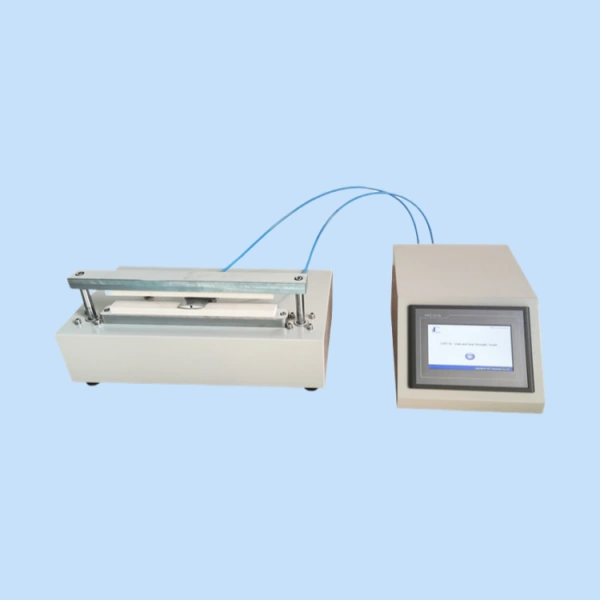
The ASTM F2054 burst test uses internal air pressurization within restraining plates to simulate real-world mechanical stresses. As pressure builds inside the package, the test identifies the weakest point—typically the seal—and records the pressure at which the package bursts. This value provides a direct indicator of the seal’s burst strength and offers insight into production consistency or potential process deviations.
This method is especially useful for high-integrity packaging such as:
- Medical device pouches
- Sterilized pharmaceutical packaging
- Flexible food pouches
- Single-use sachets and unit-dose packaging
These applications require seals to resist pressure variations during autoclaving, transport, or end-user handling.
Pouch Burst Tester and Restraining Plates
The ASTM F2054 method specifies two main equipment configurations:
- Open-package testers: Used for pouches with one unsealed side, often during manufacturing stages.
- Closed-package testers: Used for completely sealed pouches. These testers insert a sensor and nozzle through a puncture to deliver pressurized air.
In both configurations, restraining plates prevent package expansion and isolate the seal perimeter as the failure point. The burst strength test of flexible pack relies heavily on proper test conditions—plate rigidity, air flow control, and sensor sensitivity—to ensure accurate results.
Significance and Application in Flexible Pack
Understanding burst strength is vital for packaging engineers and QA professionals. This test helps:
- Ensure regulatory compliance for medical and pharmaceutical packaging.
- Improve product shelf life by identifying poor seal zones.
- Detect material weaknesses or seal integrity issues introduced during process changes.
- Compare supplier material performance.
The burst pressure test standard does not assess total package integrity or seal uniformity but can be combined with methods such as ASTM F88 (seal strength test) or ASTM F1140 (unrestrained burst testing) for a comprehensive evaluation.
Key Parameters in Burst Strength Test of Flexible Pack
Critical parameters for repeatable results include:
- Type and size of the package
- Configuration of seals (3-side or 4-side seal)
- Air flow rate and pressure increase control
- Sensor calibration and response time
- Distance and rigidity of restraining plates
For best results, test specimens must be conditioned for at least 72 hours under standard atmospheric conditions (as per ASTM E171). Failure to standardize conditions can significantly affect burst pressure readings.
Burst Strength Test Procedure Simplified
- Prepare the sample – either with or without contents, ensuring it fits between restraining plates.
- Insert the pressurization nozzle (through the open end or via puncture).
- Seal the package (in open configuration) or connect airtight mechanisms (in closed configuration).
- Pressurize at a controlled rate.
- Monitor for a rapid pressure drop indicating seal rupture.
- Record the burst pressure and observe the failure point.
Advantages of Burst Strength Test in Flexible Packaging
- Fast and objective measurement of seal performance
- High repeatability with standardized test setup
- Applicable to a wide range of flexible film materials
- Valuable during R&D, process optimization, and production quality checks
 NN
NN  EN
EN  ES
ES  DE
DE  FR
FR  IT
IT  AR
AR  KO
KO  JA
JA  RU
RU  PT
PT  VI
VI  ID
ID  BG
BG  CS
CS  DA
DA  EL
EL  ET
ET  FI
FI  HE
HE  HU
HU  LT
LT  LV
LV  NL
NL  PL
PL  RO
RO  SK
SK  SV
SV  SL
SL  UK
UK  TR
TR  BE
BE  BS
BS  HI
HI  HR
HR  KK
KK  ML
ML  MY
MY  SR
SR  TA
TA  UZ
UZ  SQ
SQ