
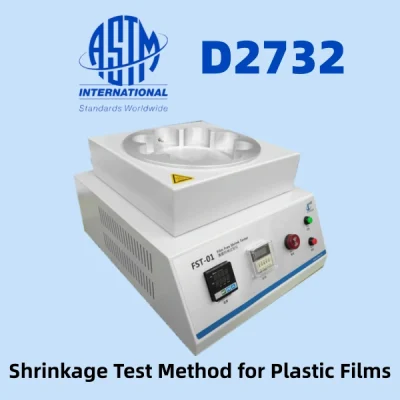
What is ASTM D2732 and Why It Matters
ASTM D2732 defines a standardized approach to evaluate the unrestrained linear thermal shrinkage of plastic film and sheeting (≤0.76 mm thickness). In practical terms, this method quantifies how much a film contracts when exposed to elevated temperatures without external constraints.
During film production—such as extrusion or orientation—internal stresses are introduced into the material structure. When heat is applied, these stresses relax, leading to dimensional shrinkage. Understanding this behavior is critical for:
- Packaging integrity (e.g., shrink wraps, labels)
- Seal performance in medical packaging
- Dimensional stability in industrial films
ASTM D2732 provides a repeatable framework to measure shrinkage across different temperatures, enabling engineers and QC teams to correlate performance with processing conditions.
Heat Shrinkage Test Method
The heat shrinkage test method described in ASTM D2732 focuses on controlled thermal exposure in a liquid bath environment.
Key technical principles include:
- Unrestrained condition: The specimen must shrink freely without mechanical interference.
- Thermal equilibrium: The specimen must reach a stable temperature to achieve maximum shrinkage.
- Bidirectional measurement: Shrinkage is evaluated in both machine direction (MD) and transverse direction (TD).
Critical insight: Shrinkage is not constant—it varies significantly with temperature. Therefore, testing at multiple temperature points provides a shrinkage profile, not just a single value.
Shrinkage Test Procedure
A standardized shrinkage test procedure ensures accuracy and reproducibility:
Specimen Preparation
- Cut 100 mm × 100 mm samples
- Use at least two specimens per test temperature
- Mark machine direction if needed
Test Execution
- Place the specimen in a free shrink holder to avoid constraint
- Record bath temperature before immersion
- Immerse the sample for ~10 seconds (or until equilibrium)
- Immediately transfer to a cooling medium
- Measure final dimensions after stabilization
Important precautions:
- Avoid preheating the sample before immersion
- Prevent specimen stretching during handling
- Ensure uniform bath temperature distribution
Shrinkage Calculation
Shrinkage(%)=L0L0−Lf×100
Where:
- L0: Initial length (typically 100 mm)
- Lf: Final length after shrinkage
This formula provides the percentage of linear shrinkage, a key parameter for material comparison and quality control.
Film Free Shrink Tester: Improving Test Accuracy
A film free shrink tester is essential for executing ASTM D2732 with high precision. Compared with manual setups, dedicated instruments offer:
- Stable temperature control (±0.3°C)
- Uniform heating via liquid medium
- Controlled immersion timing
- Consistent unrestrained conditions
For example, the Cell Instruments FST-01 Film Free Shrink Tester enables laboratories to:
- Simulate real-world shrink conditions
- Generate repeatable shrinkage data
- Reduce operator-induced variability
Its PID-controlled heating system and standardized fixtures ensure compliance with ASTM D2732 while improving operational efficiency.
Key Factors Affecting ASTM D2732 Results
To interpret results correctly, consider the following variables:
1. Material Composition
Different polymers (PET, PVC, PE) exhibit distinct shrinkage behaviors due to molecular orientation and crystallinity.
2. Processing History
Film stretching ratios, cooling rates, and annealing directly influence residual stress levels.
3. तापperature Selection
Testing at multiple temperatures reveals:
- Onset of shrinkage
- Maximum shrinkage point
- Thermal transition behavior
4. Thickness and Structure
Thicker or multilayer films may require longer immersion times to reach equilibrium.
FAQs
1. What materials are suitable for ASTM D2732 testing?
Plastic films and sheets with thickness ≤0.76 mm, including PET, PE, PVC, and multilayer laminates.
2. Why is unrestrained shrinkage important?
It reflects the intrinsic material behavior without external forces, providing true shrinkage characteristics.
3. How long should specimens be immersed?
Typically 10 seconds, but thicker or new materials may require validation to ensure full shrinkage.
4. What is the difference between MD and TD shrinkage?
MD (machine direction) aligns with film production direction, while TD is perpendicular—both impact performance differently.
5. Can ASTM D2732 be used for solvent-based shrinkage?
No, it does not account for shrinkage caused by solvent loss.
 NN
NN  EN
EN  ES
ES  DE
DE  FR
FR  IT
IT  AR
AR  KO
KO  JA
JA  RU
RU  PT
PT  VI
VI  ID
ID  BG
BG  CS
CS  DA
DA  EL
EL  ET
ET  FI
FI  HE
HE  HU
HU  LT
LT  LV
LV  NL
NL  PL
PL  RO
RO  SK
SK  SV
SV  SL
SL  UK
UK  TR
TR  BE
BE  BS
BS  HI
HI  HR
HR  KK
KK  ML
ML  MY
MY  SR
SR  TA
TA  UZ
UZ  SQ
SQ  TH
TH