
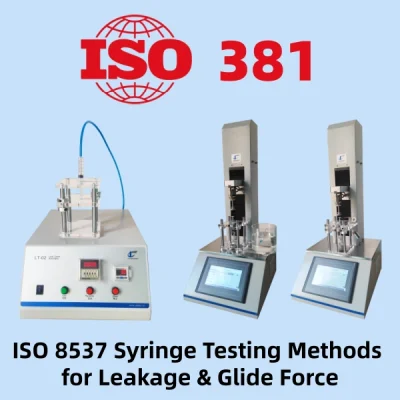
Understanding ISO 8537 and Its Importance
ISO 8537 specifies requirements and test methods for sterile single-use insulin syringes, ensuring safety, dosing accuracy, and structural integrity. For manufacturers and quality control engineers, this standard defines how to evaluate leakage resistance, piston performance, and residual volume (dead space) under controlled conditions.
The testing framework within ISO 8537 focuses on functional reliability under both negative and positive pressure, which directly impacts drug delivery accuracy and patient safety.
Syringe Air Leakage Test
The syringe air leakage test evaluates whether air passes past the piston seal during aspiration. According to ISO 8537 Annex B:
- Fill the syringe to ≥25% capacity with distilled water
- Apply vacuum pressure up to 88 kPa below atmospheric pressure
- Monitor for pressure drop over 60 seconds
- Inspect for seal leakage or stopper detachment
Key insight:
A stable manometer reading indicates proper sealing performance. Any drop suggests micro-leakage or seal failure, which can compromise dosage accuracy.
Syringe Vacuum Leakage Test
The syringe vacuum leakage test builds on the same principle but emphasizes negative pressure stability over time.
- Controlled vacuum is applied gradually
- The system is isolated using a vacuum-tight valve
- Pressure decay is recorded
Why it matters:
This test simulates real aspiration conditions. Poor vacuum retention often indicates defective piston-barrel interaction or material inconsistencies.
Piston Leakage Test Syringe
The piston leakage test syringe focuses on liquid leakage under compression conditions (Annex E):
- Apply internal pressure of 300 kPa for 30 seconds
- Introduce radial side load (0.25 N) to stress the seal
- Observe piston movement and liquid escape
Critical evaluation points:
- Seal deformation resistance
- Stability under combined axial and radial stress
- Leakage at piston interface
This test ensures the syringe maintains integrity during injection force application.
Syringe Seal Integrity Test
The syringe seal integrity test is a broader concept covering:
- Piston sealing performance
- Nozzle/hub junction tightness
- Resistance to pressure fluctuations
ISO 8537 integrates this through multiple annex methods, combining vacuum and compression testing.
Best practice:
Use automated pressure decay systems to improve repeatability and eliminate operator variability.
Syringe Nozzle Leakage Test
The syringe nozzle leakage test evaluates leakage at:
- Nozzle-to-fitting interface
- Needle hub connections
From Annex F:
- Maintain syringe at 25% volume
- Apply aspiration conditions
- Observe bubble formation at connection points
Important detail:
Ignore bubbles in the first 5 seconds—only continuous bubble formation indicates leakage.
Syringe Aspiration Leakage Test
The syringe aspiration leakage test specifically checks air ingress during plunger withdrawal:
- Pull plunger to full capacity
- Hold for 15 seconds
- Monitor for air bubble generation
This test is critical for ensuring accurate drug withdrawal without contamination or air intake.
Syringe Glide Force Testing
The syringe glide force testing (Annex C) determines force required to move the piston:
- Fill syringe to 50% capacity
- Apply vertical force using a testing machine
- Record:
- Break-loose force (initial movement)
- Glide force (continuous motion)
Performance implications:
- Too high → poor usability
- Too low → risk of uncontrolled delivery
Recommended solution:
Cell Instruments provides precision force testers capable of capturing real-time force-displacement curves, ensuring compliance with ISO 8537.
Syringe Dead Space Test
The syringe dead space test (Annex D) measures residual liquid after full discharge:
- Weigh empty syringe
- Fill completely with water
- Expel and reweigh
- Calculate residual mass (converted to volume)
Why it matters:
- Dead space affects drug dosage accuracy
- Critical for high-value or low-volume medications (e.g., insulin)
Acceptance depends on syringe type, but minimizing dead space improves clinical efficiency and cost control.
Equipment Recommendations for ISO 8537 Testing
To ensure compliance and repeatability, laboratories should adopt:
- Leakage testers (vacuum & pressure decay systems)
- Universal testing machines for glide force measurement
- High-precision balances (0.001 g accuracy)
- Custom fixtures for syringe clamping and alignment
Cell Instruments offers integrated solutions that combine automation, data acquisition, and compliance-ready test protocols, reducing operator error and improving throughput.
Frequently Asked Questions
1. What is the purpose of ISO 8537 testing?
It ensures insulin syringes meet requirements for leakage resistance, force performance, and dosing accuracy.
2. What is an acceptable leakage result?
No visible leakage and no measurable pressure drop within the specified time.
3. Why is glide force important?
It affects user control and injection precision, directly influencing patient safety.
4. How is dead space calculated?
By measuring the mass difference before and after discharge, converted to volume.
5. Can testing be automated?
Yes, modern systems integrate pressure control, force measurement, and data logging for consistent results.
 NN
NN  EN
EN  ES
ES  DE
DE  FR
FR  IT
IT  AR
AR  KO
KO  JA
JA  RU
RU  PT
PT  VI
VI  ID
ID  BG
BG  CS
CS  DA
DA  EL
EL  ET
ET  FI
FI  HE
HE  HU
HU  LT
LT  LV
LV  NL
NL  PL
PL  RO
RO  SK
SK  SV
SV  SL
SL  UK
UK  TR
TR  BE
BE  BS
BS  HI
HI  HR
HR  KK
KK  ML
ML  MY
MY  SR
SR  TA
TA  UZ
UZ  SQ
SQ  TH
TH